Follow Be Warrior

Muscle Gaining Secrets Review (Jason Ferruggia)

A review of Jasson Ferruggia’s Muscle Gaining Secrets.

I’ve had the privilege of evaluating Ferruggia’s bodybuilding program. Before I give you my review, I'll tell you upfront that I make commission on the sale of this program.  But I only promote products I believe in.  Here's the standard I use: if I would recommend it to a friend or family member, I'll recommend it to my readers.  There are a lot of affiliate offers I turn down because they are scams and rip-offs.  Now, on to my review . .  .

About the author:

Jason Ferruggia is a highly sought after, world-renowned strength & conditioning specialist. Over the last 15 years he has personally trained more than 700 athletes from over 90 different NCAA, NFL, NHL and MLB organizations. He has also worked extensively with firefighters, police officers, military personnel, Hollywood stars and entertainers.

Now, let’s take a look of some of the program’s components:

Muscle Gaining Secrets: This ebook is the central component of the program. Ferruggia tells his own story of being a skinny kid (147 lb) even after spending years in the gym. The problem, he explains, was in his training—he was trying to imitate the training methods of professional bodybuilders (splitting his routine into six days a week, etc). He learned these methods just don’t work for genetically average, natural lifters. 

Jason Ferruggia goes on to explain the Seven Critical Factors involved in designing a training program:
*Exercise Selection
*Training Volume
*Number of Reps Used
*Rep Speed
*Rest Intervals
*Training Session Length
*Training Session Frequency

Much of the ebook’s content is focused on explaining these seven factors and how to set up a program for maximum muscle gains. Ferruggia also discusses the different muscle groups and how to best train them (legs, back, etc). As a guy who has learned much through trial and error (20 years of it), I can tell you this program makes a lot of sense. This 147 page ebook is probably the best I’ve read in terms of helping you set up your training and nutrition. He covers all the basic questions a new trainee would have.

The Supplement Report: Ferruggia did an excellent job of exposing the supplement industry from a historical and personal perspective. He explains how the industry has scammed people of their hard-earned money with hype and steroid-using bodybuilders’ endorsements. Like me, he has made the mistake of spending way too much money on supplements. I sort of felt like I was reading my own story—I’ve fallen for some of the same scams (especially the ones that passed through in the 90’s). Ferruggia recommends a few cost-effective supplements (protein, creatine, etc) and encourages the readers to spend their money wisely. This report alone will save a new trainee hundreds of dollars. 

Muscle Gaining Secrets Workout Guide: This is a four phase training manual and journal. It begins with a workout for beginners and progresses to more advanced routines. It is designed to be printed out and used as a training journal. 

Muscle Gaining Secrets Meal Plans: There are nine different meal plans. Each plan is about ten pages’ worth of meals. The plans vary from 2,000 to 6,000 calories. You would simply select the one for your own caloric needs and use it as a guide. 

Composition Tracker Software: A software that helps you track your progress. 

The Exercise Database: This is a very well illustrated guide to how to properly do the exercises. Between the pictures and descriptions you shouldn’t have any trouble learning to lift properly.

10 Minute Muscle Meals: This is a nice addition to the program—quick, convenient, high protein recipes for meals and/or snacks. 

Audio Interview (MP3): Ferruggia talks about his own fitness journey in this 45-minute interview. Once again I could related to this—he’s tried several different training methods through trial and error. He also answers questions about his training program (kind of an audio summary of the MSG ebook). 

I really only found two things I disagree with:

First, Ferruggia doesn’t believe in the efficacy of Yohimbine HCL. I do think Yohimbine can help if the proper dosage and timing is implemented.

The second disagreement involves meal frequency. Ferruggia encourages trainees to eat six meals a day—every three hours. This is a controversial topic, but I’m not 100% convinced meal frequency is all that important. Having said that, I think most trainees will do much better eating at least four times a day. In other words, our advice would end up being similar: I would encourage trainees to try to eat 4-5 times a day but not fret too much over it (as long as you are getting enough protein and calories).

One final thing--Ferruggia recommends a specific brand of supplements.  I'm sure the brand he endorses is good, but be sure to shop around.  I just don't think it makes that much difference as long as you stick to the basics and use reputable brands.   

Conclusion:

Muscle Gaining Secrets is an excellent program and I think it is well worth the money. I really wish something like this had been available when I first started training. I would have wasted a lot less money on supplements and also wasted less time on inferior methods.  I think this would be especially helpful for beginners or "hardgainers" (you can see I mention some other programs below for more advanced trainees).  

If my review has helped you, please use my links to purchase this program. I only endorse programs I believe in and you’ll be supporting an honest voice in the fitness industry. Just CLICK HERE to check out the program.
source

How to Develop Explosive Arms Using Only Dumbbells

How to Develop Explosive Arms Using Only Dumbbells


We all admire certain guys who are able to maintain that perfect, clothes-filling upper body physique.  The majority of guys that are around my age (38) used to look up to guys like Arnold Schwarzenegger, Sylvester Stallone, Dolph Lundgren and even John Claude Van Damme to a certain extent.  We loved how they looked with their clothes on, as well as, off.  One thing you were sure to envy, whether they were dressed or undressed, was their “extremely defined muscular arms”.  But in real life, you seldom saw people with similar physics.
But in more recent times, physiques have started to improve as a result of better training techniques as well as people possessing superior knowledge on diets.
The key to achieving that almost perfect body is mastering and perfecting the targeting of each muscle, from the hands, all the way up to the shoulders.  I have devised a simple 15 minute plan that only requires a set of dumbbells and a bench.  Therefore this routine can be performed almost anywhere, but like I say to all of my clients, there is no substitute for hitting the gym.  The key in this routine is the “fixed” recovery period that should not last one iota longer than one minute.
To begin with, you will need to read this article in its entirety, and then visualize how and where you plan to perform the exercises that I have set out.
Here goes…
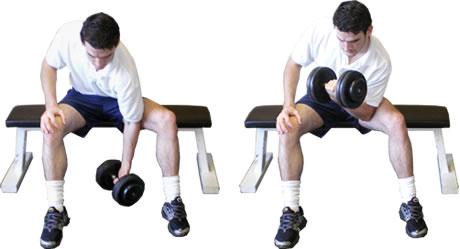
The Concentration CurlThe Concentration Curl
You start this position by sitting on the end of the bench, with your knees positioned fractionally wider than the width of your shoulders, making sure that your feet remain flat at all times.  Simply place one dumbbell in your right hand and “rest” the back of your elbow on your inner right thigh.  Next, slowly “curl” the dumbbell in a very controlled motion up towards your right shoulder. You should make sure that the rest of your body remains completely still.  To start off with, perform 10 reps before switching sides.  Once you get used to performing this exercise, you can increase your reps, as well as weight, to what you want.
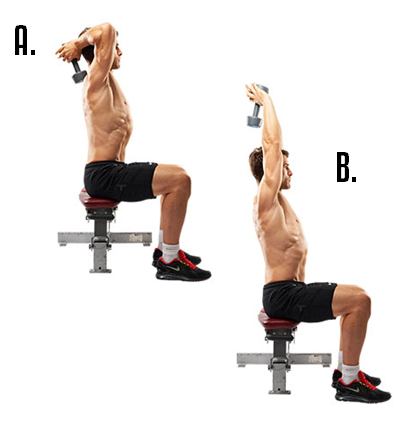
The Triceps ExtensionThe Triceps Extension
By positioning yourself comfortably on a bench, hold one dumbbell with the both of your hands.  As you are using two hands on one dumbbell, it might be a good idea to increase the weight from what you were using during the concentration curl.  Raise the dumbbell above your head until it is in a vertical position, perfectly in line with your spine (which should be perfectly straight).  Whilst concentrating on bracing your core, lower the dumbbell behind your head by bending your arms until your forearms make contact with your biceps. After that, simply reverse the motion back to the starting point where your arms are once again vertical and in line with your spine.  You must ensure that your upper arms remain completely still throughout the motion.  To start off with, perform 10 reps, and when you feel comfortable doing this exercise you can increase your reps, as well as weight.
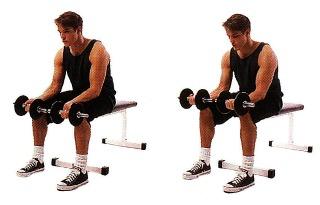
The Wrist CurlThe Wrist Curl
Seat yourself comfortably, with your knees slightly apart and your feet firmly flat on the ground. Grab a dumbbell in each hand and with your palms facing upwards, lean slightly forward so you are able to “rest” your forearms comfortably on your thighs, leaving your wrists hanging off your knees. Using only your wrists, begin curling the weight up, going high as possible.  You can alternate this movement by having your palms facing downwards and bending your wrists upwards.  I recommend that you do 10 reps in each direction.
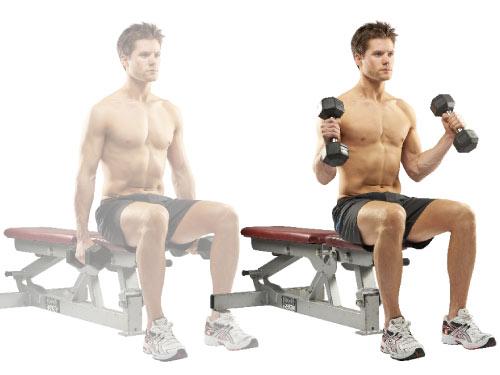
The Hammer CurlThe Hammer Curl
By sitting on the edge off your bench, and holding a dumbbell in each hand, let your arms “dangle” by your sides.  Ensuring that your back is perfectly upright, slowly curled the weights upwards until your thumbs reach your shoulders.  Make sure that you hold and squeeze for a moment, before slowly lowering your arms again.  You can quite easily vary this exercise so your wrists are facing backwards when your arms are in the “dangling” position.  I recommend that you start off by performing 10 reps in each position.
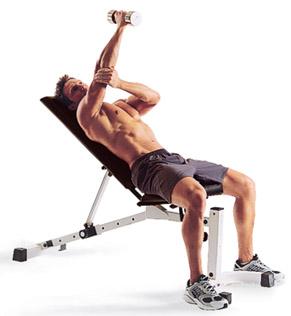
The Cross Shoulder ExtensionThe Cross Shoulder Extension
Adjust your bench to an incline position where your body is positioned at a roughly 45 degrees angle.  Make sure you are in a comfortable position, and hold a fairly light dumbbell in your left hand with your palm facing inwards, so it is nearly touching your right bicep (remember! CROSS shoulder extension).   With your right hand, support the arm by holding your left elbow.  Begin by raising the weight to an upright position and then slowly bringing it back down again.  Remember, always use very slow and controlled movements the whole time.  
Mirror the same exercise with your right hand.  To begin with, perform 10 reps and switch arms and so forth.
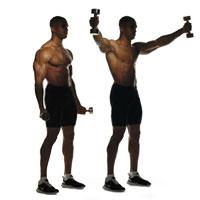
The Standing Butterfly (Scaption)The Standing Butterfly (Scaption)
Stand upright whilst holding fairly light dumbbells by your thighs, ensuring that your palms are pretty much facing each other.  Concentrate on keeping your arms straight as possible; slowly raise them both in front of you until they get to “eye level”.  Slowly lower your arms back down to the start position.  This is the best exercise to finish off your arms routine as it hits your wrists, forearms, biceps, triceps and even your outer shoulders.  Perform 10 reps to start off with, and as you go along you can increase the weight as well as the reps.
I recommend that you implement this exercise for a four-week period and I guarantee you will see and feel the difference.
Author Information...James McDuffy currently works for this leading muscle building website.  James has worked in the health and fitness industry for the last 15 years.  He is a fully qualified personal trainer and nutritionist and a former semi-professional bodybuilder.

The Best 8 Food For Fat Loss


The question “What shall I eat go get fit?” is probably one of the most popular questions ever asked. We all want to enjoy the delicious meals and stay slim and healthy at the same time. Most of us cannot resist the temptation of eating something high calorie and awfully tasty and think, “I will burn these calories in the gym tomorrow”. But it’s far not the best strategy. It’s much better and effective to combine intensive exercising with healthy, fat-burning meals. And it’s a common misunderstanding that healthy food cannot be tasty! Just check this list and try yourself:

1. Avocados for boosting your metabolism. The monounsaturating fat they contain provide burning the fat stored in your body by switching off special hormones responsible for storing it. While protecting the cells against free radicals, it speeds up your metabolism. Avocado is perfect in salads or making a smoothie with other useful products as coconut milk.


2. Salmon for burining belly fat. To achieve this aim, you should eat salmon regularly and then you’ll see the result. This is done due to the high concentration of Omega-3, which helps to improve insulin sensitivity. And by activating the thyroid hormone it improves your metabolism as well. Salmon will do in the salad or simply smoked.

3. Oysters for classy dinner. Oysters are extremely low in calories - 6 oysters contain about 50 calories. In addition to that, zinc they contain helps you to lower your appetite.

4. Get a cinnamon spice! It moves glucose faster to your cells and ensures the faster weight loss due to this. But to ensure the fat-burining effect, you’ve got to eat at least one quarter teaspoon of cinnamon a day. To make this pleasant, it’s a good idea to add it to smoothies, cocktails or apple pie.

5. Coffee. Yes, in spite of so much negative is often told about caffeine, it has its wonderful benefits! Coffee is a great adrenaline stimulator which switches on the fat burning processes in your body. A cup of coffee before the training will make the training more intensive and productive. The only thing is coffee should be black and contain caffeine.

6. Chili peppers. Capsaicin that is contained in chili warms up your body and makes it burns the fat intensively. Chili will do in any kind - dried, powdered or even raw. Add them everywhere when cooking meals - it’s up to you how much you can add!

7. Have a cup of green tea. As the researchers report, drinking four cups of green tea a day can help you lose about 6 pounds of weight in two months. What is more, green tea is extremely rich in antioxidants and it helps you to stay young longer.

8. Enjoy the fresh grapefruit. Grapefruit has several wonderful benefits. At first, it lowers the insulin levels. At second, it regulates the blood sugar and speeds up your metabolism. A glass of fresh grapefruit juice would be a wonderful idea!


I think you can continue this list basind on your personal experience. And what is the mutual benefit of all these foods is that they’re completely natural and will not damage your health as artificial weigh loss medicine can do. So, become fitter and healthier!

About the author: Paul Smith is a freelance writer. His rich life experience is the main base of his writings at custom paper writing service and his guest posts. Feel free to contact Paul at Google+.

Top 10 foods for bodybuilder and muscle gaining


Fitness is the style of life. That’s why, if you want to have strong, visible muscles, only going to gym is not enough. The result also depends on what you eat. So, if you want to gain on muscles as soon as possible, take a look at this list. These foods will help you to look the way you want:

1 - Eggs. They contain protein which is essential for building the muscle. And vitamin B12 which is also there is necessary for muscle contraction and fat breakdown.

2 - Almonds. The vitamin E in the way that is best absorbed by your body is contained there. It’s an antioxidant which prevents from free-radical damage after the exhausting training. And the more this vitamin is contained in your diet, the better your muscles will recover and grow. Two handfuls of almonds a day would be enough for that. In addition, it lowers the risk of Alzheimer's disease.

3 - Salmon is a huge source of omega-3 fatty acids and high-quality protein. It’s important for muscle building as your body should get more protein than it destroys. Moreover, the salmon lowers the risk of heart diseases.

4 - Yoghurt. It combines protein and carbohydrates, which is useful for recovering your muscles after the workout. It reduces body fat and lets your muscles grow faster.

5 - Beef is the source of iron and zinc, two main muscle-building nutrients. And the selenium, also stored there, reduces the chance of cancer.

6 - Olive oil. A lot has been told about its use. It prevents muscle breakdown and improves the condition of your whole body by decreasing the rates of cancer and heart disease.

7 - Water. 80% of our muscles contain of it. And even the decrease by 1% can influence muscle restore and your performance in general. The more dry you are, the less protein your body can use for building the muscle. So, don’t forget to drink water during the training! Moreover, those who drink over 8 glasses of water a day are less undergo to the heart attack.

8 - Coffee. The caffeine has the effect of stimulating the muscles directly. In addition, it lowers the risk of Parkinson's disease. But if you have a high blood pressure, you’d better not drink it.

9 - Cottage cheese is extremely rich in protein and is a very useful bodybuilding snack which can be eaten almost with anything.

10 - Brown rise is the base of many diets for bodybuilders. It’s a source of carbohydrates which provide the athletes with the energy that releases slowly.

As you see, these products are useful not for athletes only – they are useful for improving your health in general. Include at least some of them into your diet and you’ll notice that your performance becomes better and muscles grow much faster!


About the author: Melisa Marzett is a professional writer of College Paper Writing Service. In her spare time she meets with her friends or composes the articles about lifestyle, health, fitness and social media. Melissa can be contacted at Google+.

Top 10 Bodybuilding Tips for Beginners

Top 10 Bodybuilding Tips for Beginners


So, you finally decided to work out. You are probably inspired, have a lot of enthusiasm and daydream about the hilarious way you’ll look in several months. If such kind of activity as bodybuilding is new for you, then you should know that here are some things that can make your workout easier and bringing faster results. There are some stumbling blocks in bodybuilding, which novice should know in order to keep the enthusiasm and not to leave it halfway.

What are those points the newbie should keep in mind about bodybuilding?

  1. Find your bodybuilding idol. It’s much easier to inspire yourself for long trainings when you constantly keep the eye on someone who has already achieved the high results. So, pick a famous athlete, or simply someone who has inspired you for bodybuilding.

  1. Get the partner for your training. When you workout with your friend, it’s easier to stay motivated, as you support each other and share your achievement. Moreover, it’s just even more fun!

  1. Big thing started small. If these are your first days in the gym, don’t try to get the high result and carry the weigh as heavy as you can lift. These efforts are likely to end up an injury. Don’t overtrain, just pick the program together with your trainer and stick to it.


  1. Use the benefits of stretching. Even not beginners often underestimate how important the stretching is. The stretching lowers the level of soreness in your muscles after the heavy training. So, stretch after each workout during several minutes. It’s a good idea to stretch at home when you have spare time as well.

  1. Breathe right. The correct breathing technique will deliver the oxygen to the muscle cells, which will help you to build your muscle. The universal breathing rule for bodybuilding is, to breathe in when you lower the weigh and to breathe out when you lift it.


  1. Have a good night sleep. As nothing restores our organism better than a good sleep, allocate at least 7 hours a day to sleeping. This will help your muscles to recover faster and better.

  1. Pick a good diet. For the body builders, the diet is far the most important part of their training. If you don’t have the balanced nutrition, your muscles grow slower. It’s essential to eat before and after the training, and the nourishing should be rich in proteins and carbohydrates.

  1. Take a rest – at least for one day between the workouts. This will reduce the level of soreness the beginners experience, and won’t let you feel overtired.

  1. Maintain a good posture. Always control if you stand still while exercising. Keeping the correct posture will help you to prevent the injuries.

  1. Drink enough water. Drink it, even you don’t feel the thirst. You need to keep the hydrating levels while training. If you drink enough water, it will help you to reduce the level of fatigue. 
This a guest post from :
About the author: Paul Smith is a versatile writer. His articles cover lots of various topics, include business, health and nutrition, keeping fit and traveling. He also is a writer for the best resume writing service. Paul can be contacted at Google+

Do you have more tips for Beginners too ? share with us your opinion 

4 effective method to gain weight healthy

4 effective method to gain weight healthy

There are many people who are looking for ways to gain weight. But gaining weight and keeping it on can be very difficult for some people. However, there are some things you can do to gain weight. One of the basic ideas you need to understand is that in order for you to gain weight, you need to increase your calorie intake and engage in physical activity to build muscle. This means that you need to take in more calories by eating more calorie rich foods. You should eat nourishing foods that will help you add muscle and body mass. One of the best ways to build muscle is to engage in some form of strength or resistance training.

Set some realistic weight gain targets :


Most people start a weight gain program without taking the time to think about how they are going to do it and what they expect to achieve from their program over a given period. Set yourself targets that are realistic and achievable and reward yourself every time you reach your target. Doing this is an excellent way to get started on your weight gain program.

Change your eating habits :


It does not matter whether you want to gain or lose weight - nutrition is the single most important thing. You see, both fat loss and weight gain is all about energy in and energy out. When you are trying to lose weight you want to make sure that your daily energy output is greater than your daily energy input, whereas when you are trying to gain weight you by all means want to make sure that your daily energy input is greater than your daily energy output.

To gain weight, to make your body grow you need to give your body way more energy (calories) than it actually needs. I know that this probably sounds a little bit confusing, but all you need to do is to simply use one of the thousands of caloric calculators that are available online, figure out your caloric needs and then add extra three to five hundred calories on top of your actual caloric needs.

Start lifting weights to gain high quality lean muscle mass


When trying to gain weight you need to be really careful because if you will fail to exercise all of the extra energy that you will get from your new diet will be quickly converted into fat and instead of gaining high quality lean muscle mass you will be gaining useless body fat.

To prevent this from happening I highly recommend for you to start lifting weights. Simply start slowly and start training at least three times per week. Here are some tips for you to get started.

    Follow a body split workout plan and train large muscle groups on different days.
    During your workouts focus on big compound exercises such as barbell squats, bent over rows, deadlifts, military press and so on.
    Do no more than twelve repetition per set and never do more than four sets per exercise.
    Do no more than four exercises for large muscle groups like chest, back or legs and do no more than two exercises for smaller muscle groups like biceps or triceps.

Aim to gain weight slowly :


With gaining weight, slow is better than fast. So instead of eating junk foods and high-fat cookies and candies, expand your meals to include high calorie foods, fruit, vegetables, lean meat, whole grains and regular strength training exercises. Your diet should include foods that are higher in calories, minerals, and vitamins, as opposed to foods higher in fat, salt and sugar.

So !! you find this method effective or not, or you want to share with us method that work with you .. (feel free we're here just for you)

These are some ways to keep you motivated


These are some ways to keep you motivated
These are some ways to keep you motivated for building your body
If your motivation to workout is decreasing while building your body, here are 6 tips to keep you motivated to exercice:

1- make a notebook in which you write down your daily workouts. It is a very motivating way that makes you able to check it everyday and see how far you got with your series and exercices, so that you could get a picture about your developpement and improvements.
2- do a certain ritual before every workout to make you ready, and totally prepared for the game. There are world wide champions who totally agree with this strategy and say that they revise the series of workouts they are going to do before going to the gymnasium so that they don't ask what they are going to do today.

3- don't be a slave of your workouts. Don't let them control you. You should control them instead. So you shouldn't be following some precise workouts instead of focusing on what could be really helpful fo your body. Moreover most of bodybuilders Basically work every muscle in a day, but you should work on the parts of your body which are not well built yet instead of being commited to a certain schedule. The main goal is to work your body, not to make your body work exercices.

4- try to be different and special; if you get too tired while doing a certain exercice which is needed by your body but you can't stop it, you should try another workout, because changing your muscles exercices could be a really big challenge for you and your body, and succeding in it would be really awsome.

5- you should measure the average of your efforts and frequently check them and the growth of your muscles. Because the stress And tiredness may be the main reason that keeps you demotivated. Thus you should get some rest and good sleep then check your workouts after it.

6- take pictures of yourself using a digital camera or using your phone camera every month to keep checking your improvements and comparing between the pictures to see the difference. Eventhough you are still in the beggining of your workouts, take a picture , name it "before" And take another when you finish, name it "later" and it is the best and most apropriate way to keep motivated.

What Can I Do To Gain Weight?


Now before I go on… It's not your training program that will pack on the pounds but your nutritional habits. But first let me give you an example. So many people have some idea of their calories they need in mind. Maybe you are going for 3500-4000, but you haven't got a specific goal and you aren't counting your calories.

**THIS IS A RED FLAG** That says to me: You have no idea where to start. And as many people are when they have no foundation, they are frustrated. And justly so! So here's what you do:

Step 1: You need to figure out how many calories a day you need to consume. 3500-4000 might be a goal but how do you know that is what you need?

Step 2: You have to track your daily caloric intake closely or you are just guessing. It does not need to be accurate down to the last calorie but it needs to be an ACCURATE (within 10% or so) portrayal of what you have eaten during the day.

Most people are greatly surprised to learn that they are consuming more calories per day than they had originally thought, sometimes THOUSANDS of calories more. This does not mean that you start skipping meals; it just means that you need to have an accurate understanding of what you are putting in your body so you can balance that against what your body needs to achieve your goals.
Step 3: No more excuses for not eating. Going to college and having to work nights means you will have to plan on making meals in advance. Eating 5-6 times a day is a must. When I went to college I didn't do this.

And I didn't gain weight either. I ate my 2-3 meals a day and had fun at college. I never planned a meal. And I stayed a skinny kid.
So there you have it. You can figure out a training program all you want. You can do a very basic, somewhat heavy, 4x a week program and make more gains if you eat right then a guy who has the perfect hardcore routine and just eats to get by.

By the way, many of these hardgainers train hard and too frequent. If you have a high metabolism, you will make better gains by going heavy and training less.

If you can dedicate time to training at a specific time, you can prep some food, put in it Tupperware, baggies or whatever, throw it in a backpack and eat at scheduled intervals. And yes, being in college makes that very hard.

How Much Water Do I Need to Drink Every Day?


Yes, you can actually die from drinking too much water.
As early as 1601, Tycho Brahe (an early astronomer) was thought to have died from straining his bladder. It had been said that to leave the banquet before it concluded would be the height of bad manners, and so he remained, and that his bladder, stretched to its limit, developed an infection which he later died of. Later evidence suggested this might not be the case.

There are several other notorious cases in which infants, runners and a fraternity hazing lead to deaths from water intoxication.

While this is another sad story, it's clear that for many years, Americans have been told by the media and doctors that we are dehydrated. We need to drink more water!

Many times such things lead to scare tactic websites and total confusion. Which is why I think the following chart may help you to SAFELY determine how much water you need to stay properly hydrated for your activity without over consumption.

* this chart is meant to be a guide not an absolute *

This chart is courtesy of the ISSA www.issaonline.com
Recommended Water Intake: Step 1 Select an appropriate need factor. Need Factors

0.5 -- Sedentary no sports or training
0.6 -- Jogger or light fitness training
0.7 -- Sports participation or moderate training 3 times a week
0.8 -- Moderate daily weight training or aerobic training 0.9 -- Heavy weight training daily
1.0 -- Heavy weight training daily plus sports training or "2-a-day" training

Step 2 Multiply weight (in pounds) by the appropriate need factor to arrive at the recommended water intake in ounces per day.

Example 1 120 pounds x 0.6 = 72 ounces per day
Example 2 200 pounds x 0.7 =140 ounces per day

We recommend that you drink water eight to twelve times per day.

Example 1 72 ounces per day divided by 10 glasses = 7.2 ounces per glass
Example 2 140 ounces per day divided by 12 glasses = 11.7 ounces per glass

Do Nitric Oxide Supplements Work? (Really Do Any Supplements Work?)


Do Nitric Oxide Supplements Work? (Really Do Any Supplements Work?)

Work to do what? Give you better pumps? Yes. Build more muscle? Where’s the proof. Okay, before I go on, I'd like to point out that most of the research on NO products has been done by supplement companies that sell the products.

What’s Better? Free Weights Or Machines?

What’s Better? Free Weights Or Machines?

Most everybody asks this question. Either the first time they walk into a gym and see the selections or at some point they wonder if the bench press machine is better than the regular flat bench press with free weights.

I was a machine person for quite some time…then it hit me! Why not incorporate a little bit of both! That?s right… there?s not some rule that says if you use a machine you will never get the results you want. And there?s no rule that says you must only use free weights.

Build Big Biceps? Strong Arms And Solid Triceps?


In every gym that you go to, you will see people pumping their biceps. Biceps along with the pecs and abs are sometimes called vanity muscles because they are the most visible and therefore commands the most respect. Invariably, when you ask someone to show you his muscles, he will probably flex his biceps.

Before we discuss biceps development, I want to point out that the biceps make up only one third of your upper arm with triceps the other two-thirds. So to have an impressive arm, you must build your triceps too or the effort on your biceps will not show good results. Many people fail to realize this and that is why you see them doing curls after curls without much improvement. We will touch on triceps exercises in another article. For now, let's talk about biceps.

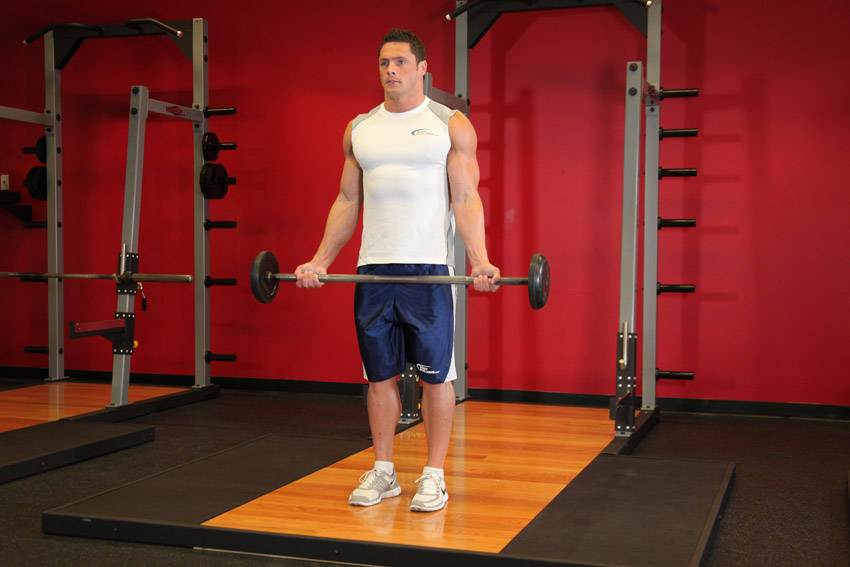
Here are some exercises that will blast your biceps. Most of you would have done some or all of these exercises. The question I am asking is, are the exercises done in the correct form and techniques because if they are not, you will most likely be wasting your time as your biceps will not grow to its full potential. Perform each exercise for 3-5 sets once or twice a week and at reps between 6-10, but make sure that at the high end of the reps, you will not be so fatigued that you can't perform another rep in good form.


a) Standing Barbell Curl/ EZ Bar


12 Secrets for gaining mass


If You really want to gain size stop reading articles out of magazines and find a trainer that knows what they are doing.

Eat organically, you are what you eat (if you give yourself a 59 cent hamburger you are giving your body 59 cent muscles that makes you look like garbage.)

Eat According to your metabolic type, "the metabolic typing diet"

Lift mainly in the 8-12 rep range

Your tempos should range from 3-1-3 to 4-1-4 and no more

You total time under tension for each lift should only last 60 sec or less (this is because you want to produce as much Testosterone and Growth Hormone.

Don't lift longer than 45 min per workout, less at a higher intensity equals more.

This would be different if you were on pro-hormones or juice, because of the recover time.

You shouldn't be performing any cardio

Lift according to your genetic makeup and your muscle fiber type if you tend to be more of an endurance athlete you will do better lifting a little higher reps, if you are more of a speed athlete you will do better lifting a little lower reps heavier weight.

Supplements and other things can help in achieving mass, as we all know what the pros use and most amateurs lifting in the gym.

Though follow science it can do way more for you than just taking some pill.

Mass is easy to gain when you lift correctly, don't waste years trying to reach your goal when you can invest in a trainer that can get you tons of results now.  And if they don't get you results fire them immediately

Words of wisdom

work harder

Less is more

Scott White

Personal Power Training


Enhanced by Zemanta

Why Is Working your Legs That Important?


Believe me… I hated leg workouts. Until I realize the true potential that a simple set of squats could unleash.

Frankly… I see the same people on the leg press machine, leg extensions, doing lunges and doing squats week after week. But for every other muscle group, it's like a new day. There are the familiar faces of course, but there are always new people. It's like working legs is an exclusive club.

And yet that is 50% of your body! Your entire lower body you will neglect because:
US Navy 030514-N-3228G-003 Aviation Maintenanc...
US Navy 030514-N-3228G-003 Aviation Maintenance Administrationman 2nd Class George F. Stowe IIIuses a military press to work his legs muscles during a workout (Photo credit: Wikipedia)
You don't like working legs
You don't want bigger legs
Your legs are big enough

But let's suppose… you do work legs. And without much weight at all. Just enough to stimulate your entire body propelling it into new levels of growth. Do you think that is possible?

How can doing squats increase our bench press? If you are stuck on bicep curls, how can incorporating legs into your routine break you thru those plateaus?

I'm here to tell you right now, as you read this, that doing leg workouts is a whole lot more than just getting bigger, more toned, or stronger legs.

Think about it. Testosterone is a primary ingredient of building muscle. So you do a hard set of tricep pushdowns. Your body responds by making more testosterone. Let's just guess at 10% more for the day. Phew. Hard workout. Good job!

Do you qualify as one of those people?

But… let's say you do a set of breathing squats at 100% intensity.

You just boosted your testosterone production 1000%.

Do you think I'm being facetious?

But back to the purpose of this question. Working your legs isn't an option. It's something you do. So you don't want bigger legs? Fine. Don't pile on the weight. Don't overload them. Just stimulate your metabolism, and stimulate your body changing. So you don't like legs? Get over it.

Fact is, by incorporating legs into your workout, you will see more gains in 6 weeks then most people do in 3 months.

Don't take my word for it. Look around at your gym? The guy with a huge upper body and tiny chicken legs. Do you want to look like that? Who are the bigger guys in your gym? Who are the women that you most want to look like? I can assure you those people do legs. Any top notch physique does legs.

Doing a cardio machine that uses legs is not the same.

So that's why working your legs is so important. Please do not make excuses. You do not have to train to failure where you cannot walk. You don't have to squat 600 lbs. You simply must train the 50% of your body that pretty much 80% of everybody just doesn't do.

Next time you are in the gym take a good look around. Notice the leg equipment. Notice the same people using that week after week.

Become one of the individuals at your gym that trains legs and discover the secret to growth.

HERE ARE THE REASONS WHY WORKING EVERY MUSCLE - NOT JUST CERTAIN ONES - IS THE SUPERIOR METHOD OF GETTING THE RESULTS YOU WANT:

1- Builds lean muscle
2- Reduces body fat levels
3- Increases energy
4- Balances blood sugar in the body
5- Increases neuromuscular efficiency
6- Improves sexual performance
7- Lowers cholesterol in the body
8- Protects against heart disease
9- Improves mood

Enhanced by Zemanta

How Much Protein Do You Need Every Day?

How Much Protein Do You Need Every Day?


The secret to figuring out how much protein you need is not by just taking some number you found like 30g and apply it to yourself. If everybody had the same needs we would all be the same. And we both know that just isn?t true. Each person is slightly different.

Let me explain. We?ve all heard that a person can only digest 25-30g of protein in one sitting. B.S.!

Just think about it. Does an IFBB professional bodybuilder intake the same amount of protein as the guy who?s 135 lbs just starting out? Even if there is a 200 lb weight difference?

The answer might shock you. NO

Needless to say, so many people just take some number, multiply that by their body weight and that?s what they think they need a day. Tell me, if a person is 35% body fat, should they use their weight or their lean weight to figure out how much protein they need?

Simple. Lean weight. Your daily protein requirements are based on your lean body weight. And how do you figure out your lean body weight?

Use the skin fold caliper home test. Go back to Question #2.

Step 1:
Take your body weight in pounds
Example: 194 lbs

Step 2:
Find your body fat % using one of the methods in Question #2
Example: 15.7% (which is .157 for the step below)

Step 3:
Take your body weight in pounds and subtract the % body fat
Example: 194 lbs – (194 x .157 = 30.45 lbs of fat) = 163.54 lbs of lean body weight

Step 4:
Take your lean body weight and multiply by 1.14
Example: 163.54 lbs x 1.14 = 186.4g of protein a day

Step 5:
Divide your daily protein requirements by 5-6 meals and that is what your protein target is for each meal.
Example: 186.4/6 meals = 31.07g of protein per meal
As you will see, a person who is 286 lbs of lean body weight will require a lot more protein. And a person who is 286 lbs should not be consuming the same amount of protein if their percentage of body fat is 35%.
But why use 1.14 for protein requirements?

The Recommended Daily Allowances (RDA) is 0.8g of protein. But that?s been shown to be too low for active athletes.

Some sites will recommend 2.0g of protein. But that seems a bit high and your body will have trouble absorbing that not to mention you will probably have a lot of excess calories which can lead to fat gains.

1.14-1.5 is the most efficient range for most active, healthy adults. This range will help build muscle but not lead you into a high protein diet. Feel free to adjust within that range if you feel you need more protein.

What actually causes muscle growth?


What actually causes muscle growth?


This is the point in the article where I could go into a long and unusually boring dissertation
about muscle physiology: Muscle fiber types, controversies over whether the muscle gets
larger or divides into new muscle cells, or both.

Number of reps, volume of training, concentric, eccentric, isometric, etc.: this is important
information for the research scientist, but not all that relevant to the hard training bodybuilder.
I mean, what are we looking for here? In a nut shell, what we want is the correct level of
stimulation to a muscle to make it larger, right? Too little stimulus and the muscle won’t grow.

Too much stimulus and the muscle doesn't grow, or worse yet, gets smaller due to injury or
inability to recuperate. The proper stimulus within a given period of time is what we are looking
for.

This brings me to another point. It is not the amount of actual weight that is the most important
factor to muscle growth, but the actual amount of stress or tension the muscle must endure
during the rep that is the crucial stimulus for growth. But some might ask “ Doesn't using
more weight mean more stress on the muscle?”

The answer is no.


If you take 405 lbs. off the rack when bench pressing and bring it down quickly without control,
bounce it off your chest and lock the elbows out hard at the top for one rep, are you
creating more stimulus to the pec muscles than if you took 300 lbs. off the rack and brought it
down with full control, pressed it up without any bounce or momentum, and did not lock the
elbows out at the top for ten reps?

I think the answer to that question is obvious, and we will examine this particular topic in the
coming sections.

The point I am trying to make here is that weight is only a factor within the variable of how

the rep itself is performed. All things being equal (i.e., each rep is performed correctly for that
exercise) weight does matter.

The more weight you can use in a given exercise, with correct form, in a given time period, for
a specified number of reps, the more stimulus for growth the muscle will experience. However,
using more weight for the sheer sake of using more weight, not taking into account how
the rep is performed, does NOT equal more stress on the muscle.

When we talk about a stimulus for growth, we must look beyond the simple micro-environment
of the muscle fiber in question. This is where bodybuilders and scientists often fall short
when trying to examine the topic of muscle growth. An examination at the level of the muscle
fiber, where the actual damage occurs, is obviously important for any study of why and how
muscles grow from weight training.

However, it is not the only factor involved leading to the increase in size and/or number of
muscle fibers in response to weight training.

When we train with weights using sufficient loads and intensity, we cause micro-trauma to
the muscle fiber(s). That is, at the level of the fiber itself, we have caused a certain amount of
controlled damage to the fibers involved.

However, muscle growth is far more involved than simple breakdown and repair. This is the
point in the report where we need to look at the concept known as the “metabolic cost of exercise.”
This concept, though complex if you map it all out, can still be reduced to its most basic
definition: Muscle growth is not a local event that happens exclusively at the level of the
muscle fiber, but is ultimately a systemic response to exercise that leads to muscle growth.

So what exactly is meant by “systemic?”


It means that when we lift a weight several things happen. At the level of the muscle, there
is controlled damage to the myofiber during muscular contraction. This damage (known as
micro-trauma) leads to remodeling (growth) of the muscle predominantly takes place during
the eccentric (negative) part of the rep.

Simply put, at the local level of the muscle fiber, it is the lowering
(negative) part of the exercise that is responsible for most of the
damage to the fiber that (hopefully) leads to muscle hypertrophy
and increases in strength.

From this information we can conclude that a controlled rep,
where the weight is lowered under full control, is a particularly
important part of a properly executed rep.

Now this is what is happening at the local level of the muscle fiber,
but as I said before, muscle growth is ultimately controlled by
the effects exercise has on the entire system. For example, as any
bodybuilder knows, growth hormone is one of several anabolic
hormones important for increasing muscle mass and shedding
body fat.

Growth hormone is a key anabolic and lipolytic (fat mobilizing) hormone that many bodybuilders
are injecting pre-contest and off season to build additional mass and burn fat. However,
growth hormone (GH), insulin, human growth factor one (IGF-1), and to a lesser degree
testosterone, can be partially manipulated by diet and exercise, so don’t think an elephant
pituitary extract enema is the only way you will ever add new muscle!

The metabolic costs of exercise can be shown in this example: When we lift weights we cause
a rise in lactic acid. Research suggests that the signal to release growth hormone in response
to exercise is related to the level of lactic acid in the blood. It is a system-wide response to the
exercise (i.e. the increasing level of lactic acid in the blood) that causes growth hormone to
be released.

In fact, the body produces many metabolites and metabolic byproducts in response to weight
lifting that contribute to the growth of lean tissues being trained.
What does this tell us?

It tells us that weight training does not just cause controlled damage to muscle fibers to stimulate
growth but has a systemic effect. It suggests weight training has a high metabolic cost
that stimulates the entire body to respond to the exercise in a positive way.

Another example of a systemic response to weight training is not commonly appreciated.

When a person first starts to train with weights, their strength climbs rather quickly, yet they
put on relatively little muscle. What is going on here? Scientists have postulated that this early
rise in strength in response to weight lifting takes place from an improved efficiency of the
nervous system, that it is a neural adaptive response.

Personally, I believe that the efficiency of the nervous system continues to play an important
role in the process of building muscle even after many years of training, but that’s another
story.

You see, this is an example that demonstrates it is not only what happens to the muscles
themselves when we train, but what happens to our entire system when we train. The nervous
system becomes more efficient, the endocrine system responds, and various enzymatic pathways
are affected. The body’s response to weight training is clearly not a local event relegated
simply to its direct effects on muscle fiber but is actively promoting a systemic response.
These are a few examples of how the systemic response to exercise leads to increases in size
and strength. The metabolic cost of exercise probably plays as crucial a role in muscle growth
as does the local stimulation to the muscles (i.e. myofiber damage caused by intense muscle
contraction).