Follow Be Warrior

Showing posts with label Training. Show all posts

How to Develop Explosive Arms Using Only Dumbbells

How to Develop Explosive Arms Using Only Dumbbells


We all admire certain guys who are able to maintain that perfect, clothes-filling upper body physique.  The majority of guys that are around my age (38) used to look up to guys like Arnold Schwarzenegger, Sylvester Stallone, Dolph Lundgren and even John Claude Van Damme to a certain extent.  We loved how they looked with their clothes on, as well as, off.  One thing you were sure to envy, whether they were dressed or undressed, was their “extremely defined muscular arms”.  But in real life, you seldom saw people with similar physics.
But in more recent times, physiques have started to improve as a result of better training techniques as well as people possessing superior knowledge on diets.
The key to achieving that almost perfect body is mastering and perfecting the targeting of each muscle, from the hands, all the way up to the shoulders.  I have devised a simple 15 minute plan that only requires a set of dumbbells and a bench.  Therefore this routine can be performed almost anywhere, but like I say to all of my clients, there is no substitute for hitting the gym.  The key in this routine is the “fixed” recovery period that should not last one iota longer than one minute.
To begin with, you will need to read this article in its entirety, and then visualize how and where you plan to perform the exercises that I have set out.
Here goes…
The Concentration CurlThe Concentration Curl
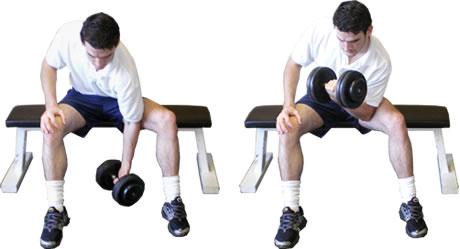
You start this position by sitting on the end of the bench, with your knees positioned fractionally wider than the width of your shoulders, making sure that your feet remain flat at all times.  Simply place one dumbbell in your right hand and “rest” the back of your elbow on your inner right thigh.  Next, slowly “curl” the dumbbell in a very controlled motion up towards your right shoulder. You should make sure that the rest of your body remains completely still.  To start off with, perform 10 reps before switching sides.  Once you get used to performing this exercise, you can increase your reps, as well as weight, to what you want.
The Triceps ExtensionThe Triceps Extension
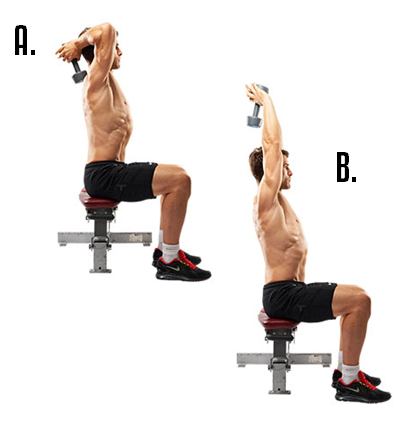
By positioning yourself comfortably on a bench, hold one dumbbell with the both of your hands.  As you are using two hands on one dumbbell, it might be a good idea to increase the weight from what you were using during the concentration curl.  Raise the dumbbell above your head until it is in a vertical position, perfectly in line with your spine (which should be perfectly straight).  Whilst concentrating on bracing your core, lower the dumbbell behind your head by bending your arms until your forearms make contact with your biceps. After that, simply reverse the motion back to the starting point where your arms are once again vertical and in line with your spine.  You must ensure that your upper arms remain completely still throughout the motion.  To start off with, perform 10 reps, and when you feel comfortable doing this exercise you can increase your reps, as well as weight.
The Wrist CurlThe Wrist Curl
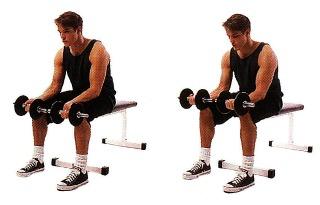
Seat yourself comfortably, with your knees slightly apart and your feet firmly flat on the ground. Grab a dumbbell in each hand and with your palms facing upwards, lean slightly forward so you are able to “rest” your forearms comfortably on your thighs, leaving your wrists hanging off your knees. Using only your wrists, begin curling the weight up, going high as possible.  You can alternate this movement by having your palms facing downwards and bending your wrists upwards.  I recommend that you do 10 reps in each direction.
The Hammer CurlThe Hammer Curl
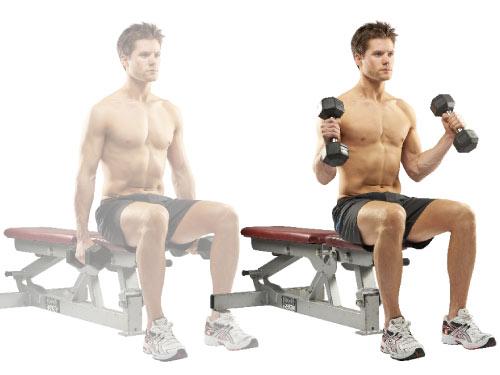
By sitting on the edge off your bench, and holding a dumbbell in each hand, let your arms “dangle” by your sides.  Ensuring that your back is perfectly upright, slowly curled the weights upwards until your thumbs reach your shoulders.  Make sure that you hold and squeeze for a moment, before slowly lowering your arms again.  You can quite easily vary this exercise so your wrists are facing backwards when your arms are in the “dangling” position.  I recommend that you start off by performing 10 reps in each position.
The Cross Shoulder ExtensionThe Cross Shoulder Extension
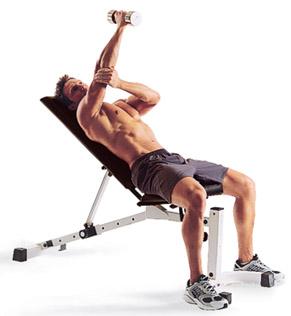
Adjust your bench to an incline position where your body is positioned at a roughly 45 degrees angle.  Make sure you are in a comfortable position, and hold a fairly light dumbbell in your left hand with your palm facing inwards, so it is nearly touching your right bicep (remember! CROSS shoulder extension).   With your right hand, support the arm by holding your left elbow.  Begin by raising the weight to an upright position and then slowly bringing it back down again.  Remember, always use very slow and controlled movements the whole time.  
Mirror the same exercise with your right hand.  To begin with, perform 10 reps and switch arms and so forth.
The Standing Butterfly (Scaption)The Standing Butterfly (Scaption)
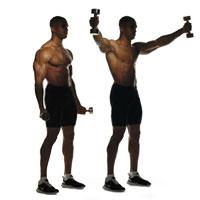
Stand upright whilst holding fairly light dumbbells by your thighs, ensuring that your palms are pretty much facing each other.  Concentrate on keeping your arms straight as possible; slowly raise them both in front of you until they get to “eye level”.  Slowly lower your arms back down to the start position.  This is the best exercise to finish off your arms routine as it hits your wrists, forearms, biceps, triceps and even your outer shoulders.  Perform 10 reps to start off with, and as you go along you can increase the weight as well as the reps.
I recommend that you implement this exercise for a four-week period and I guarantee you will see and feel the difference.
Author Information...James McDuffy currently works for this leading muscle building website.  James has worked in the health and fitness industry for the last 15 years.  He is a fully qualified personal trainer and nutritionist and a former semi-professional bodybuilder.

Top 10 Bodybuilding Tips for Beginners

Top 10 Bodybuilding Tips for Beginners


So, you finally decided to work out. You are probably inspired, have a lot of enthusiasm and daydream about the hilarious way you’ll look in several months. If such kind of activity as bodybuilding is new for you, then you should know that here are some things that can make your workout easier and bringing faster results. There are some stumbling blocks in bodybuilding, which novice should know in order to keep the enthusiasm and not to leave it halfway.

What are those points the newbie should keep in mind about bodybuilding?

  1. Find your bodybuilding idol. It’s much easier to inspire yourself for long trainings when you constantly keep the eye on someone who has already achieved the high results. So, pick a famous athlete, or simply someone who has inspired you for bodybuilding.

  1. Get the partner for your training. When you workout with your friend, it’s easier to stay motivated, as you support each other and share your achievement. Moreover, it’s just even more fun!

  1. Big thing started small. If these are your first days in the gym, don’t try to get the high result and carry the weigh as heavy as you can lift. These efforts are likely to end up an injury. Don’t overtrain, just pick the program together with your trainer and stick to it.


  1. Use the benefits of stretching. Even not beginners often underestimate how important the stretching is. The stretching lowers the level of soreness in your muscles after the heavy training. So, stretch after each workout during several minutes. It’s a good idea to stretch at home when you have spare time as well.

  1. Breathe right. The correct breathing technique will deliver the oxygen to the muscle cells, which will help you to build your muscle. The universal breathing rule for bodybuilding is, to breathe in when you lower the weigh and to breathe out when you lift it.


  1. Have a good night sleep. As nothing restores our organism better than a good sleep, allocate at least 7 hours a day to sleeping. This will help your muscles to recover faster and better.

  1. Pick a good diet. For the body builders, the diet is far the most important part of their training. If you don’t have the balanced nutrition, your muscles grow slower. It’s essential to eat before and after the training, and the nourishing should be rich in proteins and carbohydrates.

  1. Take a rest – at least for one day between the workouts. This will reduce the level of soreness the beginners experience, and won’t let you feel overtired.

  1. Maintain a good posture. Always control if you stand still while exercising. Keeping the correct posture will help you to prevent the injuries.

  1. Drink enough water. Drink it, even you don’t feel the thirst. You need to keep the hydrating levels while training. If you drink enough water, it will help you to reduce the level of fatigue. 
This a guest post from :
About the author: Paul Smith is a versatile writer. His articles cover lots of various topics, include business, health and nutrition, keeping fit and traveling. He also is a writer for the best resume writing service. Paul can be contacted at Google+

Do you have more tips for Beginners too ? share with us your opinion 

What actually causes muscle growth?


What actually causes muscle growth?


This is the point in the article where I could go into a long and unusually boring dissertation
about muscle physiology: Muscle fiber types, controversies over whether the muscle gets
larger or divides into new muscle cells, or both.

Number of reps, volume of training, concentric, eccentric, isometric, etc.: this is important
information for the research scientist, but not all that relevant to the hard training bodybuilder.
I mean, what are we looking for here? In a nut shell, what we want is the correct level of
stimulation to a muscle to make it larger, right? Too little stimulus and the muscle won’t grow.

Too much stimulus and the muscle doesn't grow, or worse yet, gets smaller due to injury or
inability to recuperate. The proper stimulus within a given period of time is what we are looking
for.

This brings me to another point. It is not the amount of actual weight that is the most important
factor to muscle growth, but the actual amount of stress or tension the muscle must endure
during the rep that is the crucial stimulus for growth. But some might ask “ Doesn't using
more weight mean more stress on the muscle?”

The answer is no.


If you take 405 lbs. off the rack when bench pressing and bring it down quickly without control,
bounce it off your chest and lock the elbows out hard at the top for one rep, are you
creating more stimulus to the pec muscles than if you took 300 lbs. off the rack and brought it
down with full control, pressed it up without any bounce or momentum, and did not lock the
elbows out at the top for ten reps?

I think the answer to that question is obvious, and we will examine this particular topic in the
coming sections.

The point I am trying to make here is that weight is only a factor within the variable of how

the rep itself is performed. All things being equal (i.e., each rep is performed correctly for that
exercise) weight does matter.

The more weight you can use in a given exercise, with correct form, in a given time period, for
a specified number of reps, the more stimulus for growth the muscle will experience. However,
using more weight for the sheer sake of using more weight, not taking into account how
the rep is performed, does NOT equal more stress on the muscle.

When we talk about a stimulus for growth, we must look beyond the simple micro-environment
of the muscle fiber in question. This is where bodybuilders and scientists often fall short
when trying to examine the topic of muscle growth. An examination at the level of the muscle
fiber, where the actual damage occurs, is obviously important for any study of why and how
muscles grow from weight training.

However, it is not the only factor involved leading to the increase in size and/or number of
muscle fibers in response to weight training.

When we train with weights using sufficient loads and intensity, we cause micro-trauma to
the muscle fiber(s). That is, at the level of the fiber itself, we have caused a certain amount of
controlled damage to the fibers involved.

However, muscle growth is far more involved than simple breakdown and repair. This is the
point in the report where we need to look at the concept known as the “metabolic cost of exercise.”
This concept, though complex if you map it all out, can still be reduced to its most basic
definition: Muscle growth is not a local event that happens exclusively at the level of the
muscle fiber, but is ultimately a systemic response to exercise that leads to muscle growth.

So what exactly is meant by “systemic?”


It means that when we lift a weight several things happen. At the level of the muscle, there
is controlled damage to the myofiber during muscular contraction. This damage (known as
micro-trauma) leads to remodeling (growth) of the muscle predominantly takes place during
the eccentric (negative) part of the rep.

Simply put, at the local level of the muscle fiber, it is the lowering
(negative) part of the exercise that is responsible for most of the
damage to the fiber that (hopefully) leads to muscle hypertrophy
and increases in strength.

From this information we can conclude that a controlled rep,
where the weight is lowered under full control, is a particularly
important part of a properly executed rep.

Now this is what is happening at the local level of the muscle fiber,
but as I said before, muscle growth is ultimately controlled by
the effects exercise has on the entire system. For example, as any
bodybuilder knows, growth hormone is one of several anabolic
hormones important for increasing muscle mass and shedding
body fat.

Growth hormone is a key anabolic and lipolytic (fat mobilizing) hormone that many bodybuilders
are injecting pre-contest and off season to build additional mass and burn fat. However,
growth hormone (GH), insulin, human growth factor one (IGF-1), and to a lesser degree
testosterone, can be partially manipulated by diet and exercise, so don’t think an elephant
pituitary extract enema is the only way you will ever add new muscle!

The metabolic costs of exercise can be shown in this example: When we lift weights we cause
a rise in lactic acid. Research suggests that the signal to release growth hormone in response
to exercise is related to the level of lactic acid in the blood. It is a system-wide response to the
exercise (i.e. the increasing level of lactic acid in the blood) that causes growth hormone to
be released.

In fact, the body produces many metabolites and metabolic byproducts in response to weight
lifting that contribute to the growth of lean tissues being trained.
What does this tell us?

It tells us that weight training does not just cause controlled damage to muscle fibers to stimulate
growth but has a systemic effect. It suggests weight training has a high metabolic cost
that stimulates the entire body to respond to the exercise in a positive way.

Another example of a systemic response to weight training is not commonly appreciated.

When a person first starts to train with weights, their strength climbs rather quickly, yet they
put on relatively little muscle. What is going on here? Scientists have postulated that this early
rise in strength in response to weight lifting takes place from an improved efficiency of the
nervous system, that it is a neural adaptive response.

Personally, I believe that the efficiency of the nervous system continues to play an important
role in the process of building muscle even after many years of training, but that’s another
story.

You see, this is an example that demonstrates it is not only what happens to the muscles
themselves when we train, but what happens to our entire system when we train. The nervous
system becomes more efficient, the endocrine system responds, and various enzymatic pathways
are affected. The body’s response to weight training is clearly not a local event relegated
simply to its direct effects on muscle fiber but is actively promoting a systemic response.
These are a few examples of how the systemic response to exercise leads to increases in size
and strength. The metabolic cost of exercise probably plays as crucial a role in muscle growth
as does the local stimulation to the muscles (i.e. myofiber damage caused by intense muscle
contraction).

The 3 Core Muscle Building Exercises You Should Be Doing

The 3 Core Muscle Building Exercises You Should Be Doing


When it comes to building muscle I like to keep things simple. It’s easy to get caught up in the hype of hot new products and exercises that promise to be the next best thing in muscle building. Theses fancy exercises and products use long “scientific like” words and explanations to show you they work to build the most muscle.

In this article I am going to get back to basics. I am going to show your three muscle building exercises you can’t afford not to do and why you should be doing them. These three exercises are the grass roots of building muscle and are essential for any serious training program.

You might find it hard to believe, but with these three exercises alone you can pack on a serious amount of muscle. I refer to these exercises as the “core” to any good program. When I start planning I muscle building program for a client I always start with these three basic exercises and build the program around them.

3 core muscle building exercises:


Squat

parallel squat
parallel squat (Photo credit: Wikipedia)
The squat is the biggest exercise for packing on serious poundage. There’s no argument about it. The squat is primarily a leg building exercise. You start the exercise with a barbell resting across your shoulders standing straight up. Then bending at the knees and hips you lower the barbell down until your thighs are almost parallel to the floor. And then push the barbell back to the starting position.

The main muscle groups pulled into action for the squat are your quadriceps, hamstrings and glutes. Secondary muscle groups include the lower back, adductors and to a certain extent your shoulder muscles. As you can see many muscle groups are recruited for this exercise making it the biggest exercise and biggest potential muscle builder.
Like all the core muscle building exercises, you should make the squat the first exercise you do on your leg training day. Because it’s the biggest exercise you want your legs to be fresh and ready. If muscle building is your goal, aim for about 8-12 reps on the squat. Because you’ll be lifting heavy weights a good warm up is vital. Squatting is very stressful for the lower body, especially the knees, so 5-10 minutes on the treadmill and some lights squats first up are recommended.
English: an exercise of chest
English: an exercise of chest (Photo credit: Wikipedia)

Bench Press

The bench pres is the king of upper body building exercises. For years the bench press has been used to measure a lifter’s strength. How many times have you been asked “how much do you bench?” I bet you’ve never been asked how much do you squat or how many chin ups can you do.

The bench is a simple yet extremely powerful exercise that targets the entire chest (pectorals), front shoulders (deltoids) and triceps. To perform a bench press you must lie on your back on a flat bench, grip the barbell at slightly wider than shoulder grip and press the bar straight down to your chest.

The bench press is the biggest upper body builder because it allows you to move the most amount of weight possible. This is its advantage over the dumbbell press. With the help of a spotter you can also push yourself to lift heavier weights. There are also other advanced bench press techniques like board presses, bench press negatives and chain presses. See our link at the bottom for more details.

Wide grip Chin Up

If you were only going to do one exercise to work your back this would be it. The wide grip chin up is the ultimate test of a lifters power to weight ratio. This muscle building exercise is very demanding on the body.

English: an exercise of upper back and biceps
English: an exercise of upper back and biceps (Photo credit: Wikipedia)
The wide grip chin up primarily hits the lats, but also targets the entire upper back, biceps and forearms. To execute this exercise you need a chin up bar or assisted chin up machine. Hold the bar in a wide grip (greater than shoulder width) with your palms facing away from your body. Start in a “hanging” position with your arms fully extended. Pull yourself up until your can get your chin over the bar and lower back to starting position.

Most people will not be able to do wide grip chin ups without some lat/back training first. You can use the assisted chin up machine or lat pull down machine to strengthen your lats before attempting wide grip chin ups. This is the most demanding back exercise you can do so it must be the first exercise in your session.

When you should be doing these exercises

Like I mentioned previously in this article, these exercises are the biggest muscle builders and also the most taxing on your body so they must be done at the beginning of your workout to get the maximum benefits. I recommend that you do up to 5 sets on each exercise and vary the way you perform these sets each week. For example, the first week you do pyramid up sets, the second week you pyramid down and the third week you do straight sets. This keeps your muscles from getting accustomed to your routine. Good luck packing on some serious pounds!


Enhanced by Zemanta

How to Design Workouts to Build Muscle

How to Design Workouts to Build Muscle


When it comes to the best workouts to build muscle, a majority of the people have no idea where to start. Their completely lost. They default to two basic routines. Basically, they will either go to the gym and do variations of bicep curls all day or stay at home and try to do sit-ups and crunches all day.
This is because there is so much confusion and chaos out there (and misinformation) that most people have really don’t know what it really takes to build muscle. As a result, they are stuck with just trying to do all the things that they see on TV or in the magazines.
This is not only a big mistake but it can lead to years in the gym with little (if any) real results. You want to build muscle. You want to get bigger and more defined. I know this because I get tons of questions about workouts to build muscle. I’m going to address some of the most common (and most important ones) here and now…

What Should I be Doing in the Gym?

Unless you are a bodybuilder, the best and most efficient workouts to build muscle are those that incorporate multiple muscle groups and will allow you to lift more weights. The focus should always be progression. This means that you want to be lifting more weight (or do an extra rep or two) compared to your last workout. This will only happen if you push yourself to newer levels and this happens the most with compound lifts.

What are “Compound Lifts”?

Compound lifts are lifts that involve more than one joint, and, as a result, more than one muscle.
The best compound lifts to do are the squats, bench presses, dead lifts and the pull-ups. If you could only do 4 exercises, this would be the four I would choose. These exercises combined work nearly every muscle in your body. They also allow you to lift heavier weights.


There’s an old saying that says, If you want to get big, you have to lift big.” These lifts allow you to lift the most weight, period. If you can bicep curl more than you bench press, then 1.) you are kind of a freak, and 2.) you aren’t building serious muscle.
Period.
You will only build muscle if you list heavier weights. Compound lifts will allow you to do that.

How Often Should I Lift Weights?

One of the best (and most overlooked) ways to build muscle is ensure that you are getting enough rest. You can have the best muscle building workouts on earth, but if you don’t get enough rest, you won’t grow.
For most people just starting out, a workout schedule of Monday, Wednesday, Friday works well. And if you split your body into two halves, upper body and lower body, you can optimize your workouts and your rest. Alternate between you upper body and lower body every other workout. So in week 1, you would do an upper body workout on Monday and Friday, and a lower body workout on Wednesday. In week 2, your upper body workout would be on Wednesday, and your lower body workout would be on Monday and Friday.
Again, the focus should be that you are able to lift more weights compared to your last workout and this will only happen if you are able to rest enough to allow your muscles to grow bigger and stronger.
As an aside, don’t neglect those lower body workouts. Working the larger muscles also helps your body produce the hormones necessary to trigger muscle growth… and there are none bigger than the ones found in your lower body. This is why squats are one of my favorite exercises.

How Many Sets and Reps Should I Do During Workouts to Build Muscle?

This is a common question. If you are just starting out, I suggest going with one warm up set and then 3 sets of 8 to 12 reps.
An example lower body workout might include squats, leg extensions, and leg curls. Each one would be done using the above set and rep scheme: 1 warm up set, and then 3 sets of 8 to 12 reps. When you can do 12 reps at a given weight, increase the weight.
If you are able to implement compound lifts into your workouts to build muscle and get sufficient rest, you will definitely start to feel stronger and look better in no time.
Questions? Comments? Leave them in the comments section below!

Enhanced by Zemanta

Scientific Principles For Effective Muscle Gain


It's an unfortunate reality that throughout the years there has been a growth of strength training techniques that have no scientific proof to back them up. Have a look at the facts presented in this outline of muscle gain principles and make up your own mind.

Below you will find Scientific Guidelines for strength training that have always been around but are not followed by many training systems these days.


1. Limited Energy Level

A strength-training program should be short and simple as you only have a limited amount of energy per training session.

Scientific studies reveal that blood sugar levels (energy) start to deplete after 30 mins, so exercise selection and the time taken to perform them is crucial.

What you should be aiming for is stimulating as many muscle fibres in the shortest period of time available.

Your blood sugar levels deplete after high intensity training (usually between 20 - 30 minutes) and remember that you need energy to recuperate after the workout.

The trick is to give yourself a high intensity workout before your blood sugar level depletes, and then you will have given your body the exercise that it requires to gain the maximum amount of muscle possible.


2. Progressive Overload

Progressive Overload is the main exercise principle you need to be aware of in order to get the results that you're after with strength training.

The two most important points are:

 Complete your exercise with perfect technique
 Push to total failure when doing a set and overload the weight on the bar progressively. (Overload your targeted muscles to beyond what there used to)

Basically this means that when the body is stressed by high intensity training    beyond its normal demands, the body will adapt to these new demands of improved strength.

When I say "normal demands," I mean what level of stress/strength your body is used to now.

An example: The set that you performed last week using the same technique and weight, your body will now have adapted to. If you stay at this level your muscles will not become stronger or bigger, so this is where the Progressive Overload plays a major part.

Once your muscles have adapted to a particular weight then it'll be time to overload them further (add more weight, speed, repetitions). You'll need to keep on repeating this process of overload if you want to become stronger.

Remember to always use GOOD TECHNIQUE. Technique must never be sacrificed for extra load.


3. Training Frequency

The sad reality is that the popular high volume type of training that you find in bodybuilding books and magazines (and used by the stars) is irrelevant to the majority of the population and has a shocking failure rate.

What is good for Joe Star is probably not good for you. Everybody has different genetics; most of us have poor genetics and are not taking steroids like the stars.

The only way the majority of us can make any gains at all is to perform short intense workouts followed by long periods of rest so that we don't overtrain.


4. Over-Compensation

Many studies conducted around the world have shown clearly that recuperation from strength training requires far more rest time than previously thought.

Infrequent, short, high intensity weight training sessions, followed by the required amount of time to recover and become stronger is necessary for you to increase your functional muscle.

Here's what you need to do - allow your body enough recuperation time for over compensation to take place, so that the muscles can adjust to their new strength and growth.


5. Exercise selection for intensity

I can't stress enough of how exercise selection is absolutely crucial. There are only a few exercises that you really need to perform. These exercises consist of multi-joint movements.

These particular exercises are far superior to that of isolation exercises (working 1 muscle group at a time) because you are required to use more muscles from every muscle group.

By using these exercises your whole body will be worked hard.

6. Visualization

Over my 20 years in the industry, I've noticed that this area is by far the most neglected by mainstream health and fitness professionals...

Most books or courses concentrate on the physical side of muscle gain or fat loss and completely neglect the mental side of things.

By training your mental state as well as your physical body you can even further progress in muscle growth.


15 Muscle Building Rules For Skinny Guys And Gals! (Part 2)


In part 1, I touched on general weight gain rules and reasons why you can't gain weight. Now it's time to get into workout specifics...

WORKOUT RULES

WORKOUT RULES


4. Stop listening to every ridiculous piece of advice you hear in the gym or read on a message board.

Recently a client of mine informed me that someone in the gym stated that he was training all wrong and he needed to train 5-6 days a week, and aim for more reps during his workout. Somewhere in the range of 15-20 reps per set.

The person giving the advice was quite confident about his recommendations, and he had an impressive physique that typically elevates him to the elusive "listen to me if you want to look like me" level in the gym. He was bigger than my client, so even though my client's "intellectual" mind knows that advice is absurd; his "unrealistic dreamer" mind took this information very seriously. So seriously that he changed his program and didn't inform me until a week or so later. This particular person had been making great progress on his current program, yet he allowed this one person’s comment to overshadow that progress and convince him that his program was inadequate. This is a mistake and it showed in his lack of further progress.

In addition, don't judge the validity of what a person says by how they look. Just because the guy is huge doesn't mean he is spewing pertinent advice for you. Many people that have big physiques are big despite of their training, not because of it. I know some huge guys that know very little about training and dieting correctly. They can do whatever and still gain muscle; unfortunately we are not that way, so we much approach things in a more intelligent way.

5. Workout Infrequently

This is the most difficult concept for many to grasp simply because it involves less action, instead of more. When we get motivated and start a new program, it’s natural to want to do something. We want to train and train and train. Thinking all along that the more you train, the more muscle you will build. Unfortunately, this could not be farther from the truth.

More training does not equal more muscle growth. Understand that the purpose of weight training is to stimulate muscle growth. That takes very little time. Once that has been done, the muscle needs to be repaired and new muscle needs to be built. That only happens when you are resting. You do not build muscle in the gym, you build muscle when resting! If you never give your body any essential “non active” time, when will it have a chance to build muscle? Think about that.

Now, add in the fact that you have a difficult time gaining weight and the importance of rest increases. Individuals who are naturally thin and have difficulty building muscle tend to require less training and more rest.

6. Focus on Multi-Jointed Lifts

Multi-jointed exercises are those that stimulate the most amounts of muscle fibers. Unlike isolation exercises which only work individual muscles, multi-jointed lifts work many different muscle groups simultaneously. For those needing to gain weight, this is ideal because these lifts put your body under the most amount of stress. This is the stress that will shock your nervous system and cause the greatest release of muscle building hormones. This results in increased muscle gain all over the body.

You can still do some isolation work; however it should not be the focus of your workouts, and should only come after your multi-jointed lifting is complete.

7. Focus on Using Free Weights

Free weights are preferred over machines for many reasons, but most importantly because they allow the stimulation of certain supporting muscle groups when training. Stimulating these stabilizer and synergistic muscles will allow you go get stronger, and ultimately build more muscle faster. Yes, some can most likely still build large amounts of muscle using machines, but why make it more difficult if you already have a difficult time gaining weight?

8. Lift a weight that is challenging for you

Building mass involves lifting relatively heavy weight. This is necessary because the muscle fibers that cause the most amount of muscle size growth (called Type IIB) are best stimulated by the lifting of heavy weight. A heavy weight as one that only allows you to perform 4-8 reps before your muscles fail.

Using a lighter weight and doing more reps can stimulate some Type IIB fibers, but again if you have a difficult time gaining weight, why make it more difficult? You need to try and stimulate as many as you can with the use of heavy weights.

9. Focus more on the eccentric portion of the exercise.

When you lift a weight, it can be divided into three distinct periods. The positive, the negative and midpoint. The concentric or “positive” motion usually involves the initial push or effort when you begin the rep. The midpoint is signaled by a short pause before reversing and returning to the starting position. The eccentric, or “negative” portion of each lift is characterized by your resistance against then natural pull of the weight.

For example, when doing push-ups, the positive motion is the actual pushing up motion. Once you have pushed all the way up, you hit the mid point. The negative motion begins when you start to lower yourself back down. Most would simply lower themselves as fast as they pushed up, but I recommend extending and slowing down this portion. Slowing down the eccentric part of the lift will help to stimulate more muscle growth. It actually activates more of the Type IIB fibers mentioned about in Rule 7.

10. Keep your workout short but intense.

Your goal should be to get in, stimulate your muscles and then get out as quickly as possible. It is not necessary to do large amounts of exercisers per body part trying to target every muscle and hit every “angle”. This should only be a concern of someone with an already developed, mature physique who is trying to improve weak areas.

If you have no pec, don’t concern yourself with trying to target inner, outer, upper, lower or whatever. Just work your chest. You should do no more than 2-3 exercises per body part. That’s it. Doing more than that won’t build more muscle, faster. In fact it could possibly lead to muscle loss. Long training sessions cause catabolic hormone levels to rise dramatically. Catabolic hormones are responsible for breaking down muscle tissue resulting in MUSCLE LOSS. While at the same time, long training sessions suppress the hormones that actually build muscle.

If you don’t want to lose muscle during your workouts, I suggest limiting your sessions to no more than 60-75 minutes MAXIMUM. Less if you can.

11. Limit your aerobic activity and training

Honestly, I do not do any aerobic activity when I am trying to gain weight. This is mainly because it interferes with the important “non-active” time my body needs for muscle building and recovery. I do understand that people have lives and other activities that they don't want to give up, so it must be kept to a minimum. It won’t hurt your progress as long as you don’t over do it. If you find that you are doing more aerobic activity weight training, that’s overdoing it.

I also don’t recommend it because people tend do it for the wrong reasons. Many start aerobic activity because they believe it will help them to lose fat. While that is true, it won’t do so on a high calorie mass diet. To lose fat, you need to be eating fewer calories.

12. Don’t program hop

Here’s how it usually happens. You’ve just read about a new exercise or workout that is supposed to pack on the mass. Now, even though you had already started another training program a few weeks ago, you are tired of it and really want to start this routine instead because it sounds better.

I call these people, “program hoppers”. They are very enthusiastic when starting a new program, but they never follow it long enough to actually see any results. They are easily distracted and love to drop whatever they may be doing to follow the latest "hot" workout or exercise.

My advice is don’t do it. This is a bad habit that never leads to a positive outcome. Understand that it takes time for any program to work. To be successful, you must follow your program consistently. Yes, there are many different training methods and interesting routines out there, but you can’t do them all at the same time and jumping around won’t allow enough time for any of them to actually be effective for you. Pick one that is focused on your current goal and stick with it. There will be plenty of time to try the others later, but NOT NOW.

Easy Way To Build Muscle


Essentially if you plan to make any gains you must adhere 
to these principles in order to be successful. They are as 
follows: 

1) Eat Enough 


Good Enough to Eat - Cuisine
Good Enough to Eat - Cuisine (Photo credit: ZagatBuzz)
Some bodybuilders think that starving themselves will help 
their muscles to grow. Wrong! One of the most fundamental 
aspects of muscle development is nutrients. Without the 
correct amount of nutrients being available to your 
respective muscles, development and growth cannot occur. 

Therefore, it is highly recommended that you eat small meals 
every 2-3 hours whilst bodybuilding, this will essentially 
ensure that there is always a constant supply of nutrients 
to your muscles. However, try to avoid over eating as this 
may result in adipose tissue gaining (fat tissue) and not 
muscle mass. 

2) Lift heavy weights 

getting-huge.jpg
getting-huge.jpg (Photo credit: ericmcgregor)

What most people fail to realize is that in order for 
muscle to grow, you must stress the muscle. Whereby after 
and during your workout, your body and more importantly you 
muscle goes through growth. In theory, you muscle says "Hey, 
I don't want to go through that pain again. I know! I'll 
grow more muscle mass so that lifting won't cause me anymore 
pain." 

Carrying on from this, lifting small weights in which you 
are extremely comfortable with will not ensure that muscle 
will grow, rather it will ensure that the muscle has a great 
deal of stamina. Therefore, to ensure huge gains you must 
stress the body, inducing the body to react and consequently 
incredible muscle mass is achieved. 


3) Sleep 


Bronze statue of Eros sleeping, 3rd century BC...
Bronze statue of Eros sleeping, 3rd century BC–early 1st century AD (Photo credit: Wikipedia)
Your muscles grow most when you're sleeping. Its at this 
stage when body has a chance to recover from the physical 
stress of the day. It also allows for the body to react to 
possible future problems that may occur; therefore more 
muscle is growth is achieved when you're sleeping. 

Therefore, most bodybuilders and fitness trainers recommend 
that you receive at least 8 hours of good, uninterrupted 
sleep each night. However, 10 hours of sleep is preferred 
as the more you get the better, but we all know some people 
cannot achieve this, so just try and get the most possible. 
Your mind, body and muscles will love you for it! 

Okay; these are some basic steps of which all bodybuilders 
and those that want to gain muscle mass understand. But it’s 
these fundamentals that ensure you are successful at the gym.

Enhanced by Zemanta