Follow Be Warrior

Showing posts with label Workout. Show all posts

How to Develop Explosive Arms Using Only Dumbbells

How to Develop Explosive Arms Using Only Dumbbells


We all admire certain guys who are able to maintain that perfect, clothes-filling upper body physique.  The majority of guys that are around my age (38) used to look up to guys like Arnold Schwarzenegger, Sylvester Stallone, Dolph Lundgren and even John Claude Van Damme to a certain extent.  We loved how they looked with their clothes on, as well as, off.  One thing you were sure to envy, whether they were dressed or undressed, was their “extremely defined muscular arms”.  But in real life, you seldom saw people with similar physics.
But in more recent times, physiques have started to improve as a result of better training techniques as well as people possessing superior knowledge on diets.
The key to achieving that almost perfect body is mastering and perfecting the targeting of each muscle, from the hands, all the way up to the shoulders.  I have devised a simple 15 minute plan that only requires a set of dumbbells and a bench.  Therefore this routine can be performed almost anywhere, but like I say to all of my clients, there is no substitute for hitting the gym.  The key in this routine is the “fixed” recovery period that should not last one iota longer than one minute.
To begin with, you will need to read this article in its entirety, and then visualize how and where you plan to perform the exercises that I have set out.
Here goes…
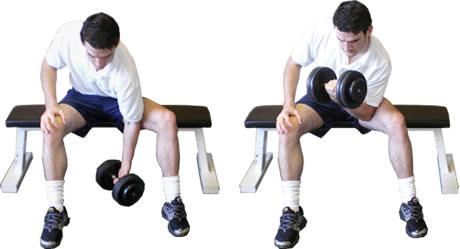
The Concentration CurlThe Concentration Curl
You start this position by sitting on the end of the bench, with your knees positioned fractionally wider than the width of your shoulders, making sure that your feet remain flat at all times.  Simply place one dumbbell in your right hand and “rest” the back of your elbow on your inner right thigh.  Next, slowly “curl” the dumbbell in a very controlled motion up towards your right shoulder. You should make sure that the rest of your body remains completely still.  To start off with, perform 10 reps before switching sides.  Once you get used to performing this exercise, you can increase your reps, as well as weight, to what you want.
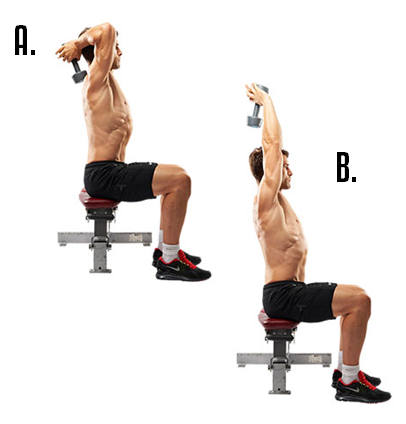
The Triceps ExtensionThe Triceps Extension
By positioning yourself comfortably on a bench, hold one dumbbell with the both of your hands.  As you are using two hands on one dumbbell, it might be a good idea to increase the weight from what you were using during the concentration curl.  Raise the dumbbell above your head until it is in a vertical position, perfectly in line with your spine (which should be perfectly straight).  Whilst concentrating on bracing your core, lower the dumbbell behind your head by bending your arms until your forearms make contact with your biceps. After that, simply reverse the motion back to the starting point where your arms are once again vertical and in line with your spine.  You must ensure that your upper arms remain completely still throughout the motion.  To start off with, perform 10 reps, and when you feel comfortable doing this exercise you can increase your reps, as well as weight.
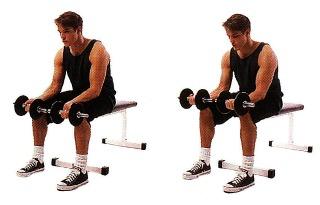
The Wrist CurlThe Wrist Curl
Seat yourself comfortably, with your knees slightly apart and your feet firmly flat on the ground. Grab a dumbbell in each hand and with your palms facing upwards, lean slightly forward so you are able to “rest” your forearms comfortably on your thighs, leaving your wrists hanging off your knees. Using only your wrists, begin curling the weight up, going high as possible.  You can alternate this movement by having your palms facing downwards and bending your wrists upwards.  I recommend that you do 10 reps in each direction.
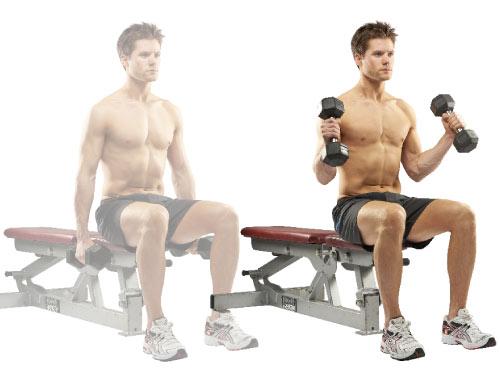
The Hammer CurlThe Hammer Curl
By sitting on the edge off your bench, and holding a dumbbell in each hand, let your arms “dangle” by your sides.  Ensuring that your back is perfectly upright, slowly curled the weights upwards until your thumbs reach your shoulders.  Make sure that you hold and squeeze for a moment, before slowly lowering your arms again.  You can quite easily vary this exercise so your wrists are facing backwards when your arms are in the “dangling” position.  I recommend that you start off by performing 10 reps in each position.
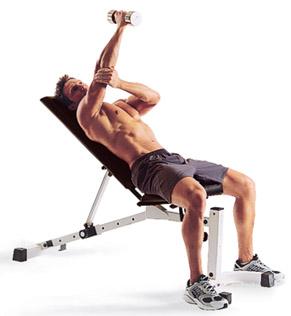
The Cross Shoulder ExtensionThe Cross Shoulder Extension
Adjust your bench to an incline position where your body is positioned at a roughly 45 degrees angle.  Make sure you are in a comfortable position, and hold a fairly light dumbbell in your left hand with your palm facing inwards, so it is nearly touching your right bicep (remember! CROSS shoulder extension).   With your right hand, support the arm by holding your left elbow.  Begin by raising the weight to an upright position and then slowly bringing it back down again.  Remember, always use very slow and controlled movements the whole time.  
Mirror the same exercise with your right hand.  To begin with, perform 10 reps and switch arms and so forth.
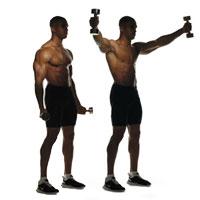
The Standing Butterfly (Scaption)The Standing Butterfly (Scaption)
Stand upright whilst holding fairly light dumbbells by your thighs, ensuring that your palms are pretty much facing each other.  Concentrate on keeping your arms straight as possible; slowly raise them both in front of you until they get to “eye level”.  Slowly lower your arms back down to the start position.  This is the best exercise to finish off your arms routine as it hits your wrists, forearms, biceps, triceps and even your outer shoulders.  Perform 10 reps to start off with, and as you go along you can increase the weight as well as the reps.
I recommend that you implement this exercise for a four-week period and I guarantee you will see and feel the difference.
Author Information...James McDuffy currently works for this leading muscle building website.  James has worked in the health and fitness industry for the last 15 years.  He is a fully qualified personal trainer and nutritionist and a former semi-professional bodybuilder.

Top 10 Bodybuilding Tips for Beginners

Top 10 Bodybuilding Tips for Beginners


So, you finally decided to work out. You are probably inspired, have a lot of enthusiasm and daydream about the hilarious way you’ll look in several months. If such kind of activity as bodybuilding is new for you, then you should know that here are some things that can make your workout easier and bringing faster results. There are some stumbling blocks in bodybuilding, which novice should know in order to keep the enthusiasm and not to leave it halfway.

What are those points the newbie should keep in mind about bodybuilding?

  1. Find your bodybuilding idol. It’s much easier to inspire yourself for long trainings when you constantly keep the eye on someone who has already achieved the high results. So, pick a famous athlete, or simply someone who has inspired you for bodybuilding.

  1. Get the partner for your training. When you workout with your friend, it’s easier to stay motivated, as you support each other and share your achievement. Moreover, it’s just even more fun!

  1. Big thing started small. If these are your first days in the gym, don’t try to get the high result and carry the weigh as heavy as you can lift. These efforts are likely to end up an injury. Don’t overtrain, just pick the program together with your trainer and stick to it.


  1. Use the benefits of stretching. Even not beginners often underestimate how important the stretching is. The stretching lowers the level of soreness in your muscles after the heavy training. So, stretch after each workout during several minutes. It’s a good idea to stretch at home when you have spare time as well.

  1. Breathe right. The correct breathing technique will deliver the oxygen to the muscle cells, which will help you to build your muscle. The universal breathing rule for bodybuilding is, to breathe in when you lower the weigh and to breathe out when you lift it.


  1. Have a good night sleep. As nothing restores our organism better than a good sleep, allocate at least 7 hours a day to sleeping. This will help your muscles to recover faster and better.

  1. Pick a good diet. For the body builders, the diet is far the most important part of their training. If you don’t have the balanced nutrition, your muscles grow slower. It’s essential to eat before and after the training, and the nourishing should be rich in proteins and carbohydrates.

  1. Take a rest – at least for one day between the workouts. This will reduce the level of soreness the beginners experience, and won’t let you feel overtired.

  1. Maintain a good posture. Always control if you stand still while exercising. Keeping the correct posture will help you to prevent the injuries.

  1. Drink enough water. Drink it, even you don’t feel the thirst. You need to keep the hydrating levels while training. If you drink enough water, it will help you to reduce the level of fatigue. 
This a guest post from :
About the author: Paul Smith is a versatile writer. His articles cover lots of various topics, include business, health and nutrition, keeping fit and traveling. He also is a writer for the best resume writing service. Paul can be contacted at Google+

Do you have more tips for Beginners too ? share with us your opinion 

15 Muscle Building Rules For Skinny Guys And Gals! (Part 2)


In part 1, I touched on general weight gain rules and reasons why you can't gain weight. Now it's time to get into workout specifics...

WORKOUT RULES

WORKOUT RULES


4. Stop listening to every ridiculous piece of advice you hear in the gym or read on a message board.

Recently a client of mine informed me that someone in the gym stated that he was training all wrong and he needed to train 5-6 days a week, and aim for more reps during his workout. Somewhere in the range of 15-20 reps per set.

The person giving the advice was quite confident about his recommendations, and he had an impressive physique that typically elevates him to the elusive "listen to me if you want to look like me" level in the gym. He was bigger than my client, so even though my client's "intellectual" mind knows that advice is absurd; his "unrealistic dreamer" mind took this information very seriously. So seriously that he changed his program and didn't inform me until a week or so later. This particular person had been making great progress on his current program, yet he allowed this one person’s comment to overshadow that progress and convince him that his program was inadequate. This is a mistake and it showed in his lack of further progress.

In addition, don't judge the validity of what a person says by how they look. Just because the guy is huge doesn't mean he is spewing pertinent advice for you. Many people that have big physiques are big despite of their training, not because of it. I know some huge guys that know very little about training and dieting correctly. They can do whatever and still gain muscle; unfortunately we are not that way, so we much approach things in a more intelligent way.

5. Workout Infrequently

This is the most difficult concept for many to grasp simply because it involves less action, instead of more. When we get motivated and start a new program, it’s natural to want to do something. We want to train and train and train. Thinking all along that the more you train, the more muscle you will build. Unfortunately, this could not be farther from the truth.

More training does not equal more muscle growth. Understand that the purpose of weight training is to stimulate muscle growth. That takes very little time. Once that has been done, the muscle needs to be repaired and new muscle needs to be built. That only happens when you are resting. You do not build muscle in the gym, you build muscle when resting! If you never give your body any essential “non active” time, when will it have a chance to build muscle? Think about that.

Now, add in the fact that you have a difficult time gaining weight and the importance of rest increases. Individuals who are naturally thin and have difficulty building muscle tend to require less training and more rest.

6. Focus on Multi-Jointed Lifts

Multi-jointed exercises are those that stimulate the most amounts of muscle fibers. Unlike isolation exercises which only work individual muscles, multi-jointed lifts work many different muscle groups simultaneously. For those needing to gain weight, this is ideal because these lifts put your body under the most amount of stress. This is the stress that will shock your nervous system and cause the greatest release of muscle building hormones. This results in increased muscle gain all over the body.

You can still do some isolation work; however it should not be the focus of your workouts, and should only come after your multi-jointed lifting is complete.

7. Focus on Using Free Weights

Free weights are preferred over machines for many reasons, but most importantly because they allow the stimulation of certain supporting muscle groups when training. Stimulating these stabilizer and synergistic muscles will allow you go get stronger, and ultimately build more muscle faster. Yes, some can most likely still build large amounts of muscle using machines, but why make it more difficult if you already have a difficult time gaining weight?

8. Lift a weight that is challenging for you

Building mass involves lifting relatively heavy weight. This is necessary because the muscle fibers that cause the most amount of muscle size growth (called Type IIB) are best stimulated by the lifting of heavy weight. A heavy weight as one that only allows you to perform 4-8 reps before your muscles fail.

Using a lighter weight and doing more reps can stimulate some Type IIB fibers, but again if you have a difficult time gaining weight, why make it more difficult? You need to try and stimulate as many as you can with the use of heavy weights.

9. Focus more on the eccentric portion of the exercise.

When you lift a weight, it can be divided into three distinct periods. The positive, the negative and midpoint. The concentric or “positive” motion usually involves the initial push or effort when you begin the rep. The midpoint is signaled by a short pause before reversing and returning to the starting position. The eccentric, or “negative” portion of each lift is characterized by your resistance against then natural pull of the weight.

For example, when doing push-ups, the positive motion is the actual pushing up motion. Once you have pushed all the way up, you hit the mid point. The negative motion begins when you start to lower yourself back down. Most would simply lower themselves as fast as they pushed up, but I recommend extending and slowing down this portion. Slowing down the eccentric part of the lift will help to stimulate more muscle growth. It actually activates more of the Type IIB fibers mentioned about in Rule 7.

10. Keep your workout short but intense.

Your goal should be to get in, stimulate your muscles and then get out as quickly as possible. It is not necessary to do large amounts of exercisers per body part trying to target every muscle and hit every “angle”. This should only be a concern of someone with an already developed, mature physique who is trying to improve weak areas.

If you have no pec, don’t concern yourself with trying to target inner, outer, upper, lower or whatever. Just work your chest. You should do no more than 2-3 exercises per body part. That’s it. Doing more than that won’t build more muscle, faster. In fact it could possibly lead to muscle loss. Long training sessions cause catabolic hormone levels to rise dramatically. Catabolic hormones are responsible for breaking down muscle tissue resulting in MUSCLE LOSS. While at the same time, long training sessions suppress the hormones that actually build muscle.

If you don’t want to lose muscle during your workouts, I suggest limiting your sessions to no more than 60-75 minutes MAXIMUM. Less if you can.

11. Limit your aerobic activity and training

Honestly, I do not do any aerobic activity when I am trying to gain weight. This is mainly because it interferes with the important “non-active” time my body needs for muscle building and recovery. I do understand that people have lives and other activities that they don't want to give up, so it must be kept to a minimum. It won’t hurt your progress as long as you don’t over do it. If you find that you are doing more aerobic activity weight training, that’s overdoing it.

I also don’t recommend it because people tend do it for the wrong reasons. Many start aerobic activity because they believe it will help them to lose fat. While that is true, it won’t do so on a high calorie mass diet. To lose fat, you need to be eating fewer calories.

12. Don’t program hop

Here’s how it usually happens. You’ve just read about a new exercise or workout that is supposed to pack on the mass. Now, even though you had already started another training program a few weeks ago, you are tired of it and really want to start this routine instead because it sounds better.

I call these people, “program hoppers”. They are very enthusiastic when starting a new program, but they never follow it long enough to actually see any results. They are easily distracted and love to drop whatever they may be doing to follow the latest "hot" workout or exercise.

My advice is don’t do it. This is a bad habit that never leads to a positive outcome. Understand that it takes time for any program to work. To be successful, you must follow your program consistently. Yes, there are many different training methods and interesting routines out there, but you can’t do them all at the same time and jumping around won’t allow enough time for any of them to actually be effective for you. Pick one that is focused on your current goal and stick with it. There will be plenty of time to try the others later, but NOT NOW.

15 Muscle Building Rules For Skinny Guys And Gals! (Part 1)


WHY CAN'T YOU GAIN WEIGHT?

Though there may be many reasons why you may be thin, the most apparent reason is because of your genetics. If your parents are naturally thin or have a small body frame, then you will most likely have the same small body type.

To some degree, your size can also be controlled by your metabolism. If you have a difficult time gaining weight of any kind (fat or muscle) then you most likely have a fast metabolism. That simply means that your body burns calories at a faster than normal rate. You must take this into account whenever you are considering a particular diet or training program. Is it geared towards someone with your metabolism and goal?

Now as you know, there are many ways to train. Hundreds, thousands even. Some work and some do not, but for the specific goal of gaining weight, there are a few UNIVERSAL things that all skinny guys must do.

Though much of the information I cover here is not as "magical" as you may like, I consider these rules to be the basics with regard to weight gain. These are not all of the answers, but they are definite elements that MUST be addressed in any successful weight gain program.

You should be able to easily integrate these rules into your current program to make it more suitable for your particular body and goals.

GENERAL RULES

1.Get the proper information that pertains to your SPECIFIC condition and goals.

The first big problem I find in most people is the lack of correct information. Yes you are motivated and doing things, but your effort is wasted on incorrect dieting and training information. Basically, skinny guys are taking advice from people who have never had a weight gain problem. Want to know how to gain weight? Then find someone who has walked your shoes. Someone who has been where you are.

2.Set a specific goal and create a plan of attack.

If you were to drive cross country to another city, would you just start driving randomly, or would you plan a route that would get you quickly and efficiently?

Think of your plan as a road map and your goal as your destination. Without a plan and a specific goal you will be without focus and can easily get lost or side tracked. This happens more often than you know. I see many people in the gym just doing whatever, or just eating whatever -- no plan or specific goal. They wonder why they don't make progress. They have no focus.

Having a specific program to follow allows you to take action each day. This action is focused on specifically getting you to your destination quickly. There is no thinking, debating or guessing. You just do it. A specific plan provides necessary daily structure that not only keeps you on the road moving forward, it also helps to develop good eating and training habits that will benefit you long after you have reached your destination.

3.Have confidence in yourself and belief in what you are doing.

Let’s face it; we live in a cruel world. Hate and jealously is everywhere. For most people who begin a fitness program to improve themselves, getting started will be half the battle. The other half will be staying motivated throughout the constant onslaught of negativity from others. A few negative words can do serious damage if you allow it.

The most insulting things you hear may be from friends, co-workers and acquaintances at the gym. People hate change. It makes them insecure, because they suddenly discover there’s more to you than they were probably willing to admit. They fear that you may actually achieve your goal. It makes them look less “superior”.

Once you have begun your plan, you must have faith and believe in what you are doing. Stay focused and avoid overly critical or negative people. If you have to, keep your business to yourself. When I first began my program, I stopped talking about what I was doing because I got tired of hearing things like “you can’t do that”, “that’s impossible”, “you’re wasting your time and money”. Funny thing is, now those people are constantly bugging me for advice.

It’s your life. It’s your body. It’s your dream. Don’t allow your success or failure to rest in the hands of others.

In Part 2 of this article, I will cover your workout rules and guidelines to MAKE SURE you gain muscle.


Why Crunches and Sit Ups do NOT Get You Six Pack Abs


Why Crunches and Sit Ups do NOT Get You Six Pack Abs

Doing countless crunches and sit ups are by far the most common exercise mistake for anyone who wants to slim down their midsection. The thought is that doing hundreds of crunches and sit ups will work the abs so hard that the fat covering them will disappear. If this were true, you would see people walking around with toned and defined abs and a soft and flabby body everywhere else.

Here's something to think about: we're always focusing on the abs but you ever noticed that the people who have the best abs also have a great body everywhere else? This is by design - not by coincidence. The idea that doing lots of crunches is going to get you six pack abs is a myth that is known as "spot reduction". Fat burning is not a local phenomenon. When you do bicep curls your biceps do not pull fat from your arm for energy, so why would crunches reduce the fat around your waistline? More on that soon.

If you want to see your abs then know this:

It all comes down to the basics of losing body fat, which is calories in vs. calories out.

In order to lose body fat you need to create a caloric deficit, which means that your body is burning more calories than it is taking in. Your diet constitutes how many calories you are taking in and your level of physical activity is what constitutes how many calories you burn off (in addition to your resting metabolism).

The biggest problem with crunches and sit ups are that they do not give you a very big "bang for your buck" with regard to caloric expenditure. You can spend 15 minutes doing crunches and get your abs working very hard, but you will only burn a small number of calories. This is not enough to have a large impact on losing body fat.

A simple way to understand this is to think about the difference workload between total body exercise and crunches.


Here is an example to get you started.

If you do an intense total body circuit (ex. squats, pushups, mountain climbers) for 15 minutes and compare that to 15 minutes of crunches, which do you think will burn more overall calories?

The answer is the total body exercise because you are working more muscles which in turn makes you burn more calories. The more calories you burn the more fat you will lose on your entire body, thus exposing your abs to the world. This is why total body training is so effective for losing body fat. It gives you a big "bang for your buck" because you are able to get so much work done in a relatively short amount of time.

Doing hundreds of crunches and sit ups are simply not a very efficient way to spend your time exercising. Your goal with exercising to lose body fat is to burn a lot of calories and to boost your metabolism.

Despite this overwhelming evidence - the general consensus is that doing crunches and sit ups will help you lose belly fat. It is very common to hear questions such as "I am doing lots of crunches but my waistline is not getting any smaller, what am I doing wrong?"

It is not that crunches are absolutely "wrong"; it is just that they are one of the least efficient ways to burn calories. Trying to use only crunches as your primary means to burn significant calories is like trying to lower your body fat by doing bicep curls, calf raises, or tricep extensions. All of these exercises burn a small amount of calories, because they are working small muscle groups.

Getting six pack abs is simply a matter of having a low body fat percentage. Lowering your body fat comes from creating a caloric deficit that forces your body to use stored fat as energy.

Even though crunches are not the best way to lose belly fat, you will find in the next section that training your abdominals according to their true function can help you get tighter abs faster.

Once you have stripped off all the fat THEN crunches are the best way to sharpen, define, and create a head turning 6-Pack, right??

No.

Keep reading and you'll see why.

Main Lesson: Getting six pack abs is largely a matter of losing body fat. Total body training burns more calories than crunches and sit ups, and it is a much more effective and efficient way of training to get the most benefit in the least amount of time.

8 Proven Strategies For Maximum Muscle Gains


8 Proven Strategies For Maximum Muscle Gains


There is so much conflicting information out there when it comes to the topic of building muscle, and sometimes it can be very difficult to know where to start. If you’re an average beginner looking for some basic guidelines to follow in the gym, the following 8 points will start you off on the right track.

1) Train With Weights and Focus On Compound, Free Weight Movements.

If you want to make solid, noteworthy gains in muscle size and strength, you absolutely must train with free weights and focus on basic, compound exercises. A compound exercise is any lift that stimulates more than one muscle group at a time. Examples of these lifts are the squat, deadlift, bench press, chin up, barbell row, overhead press, dip and lunge. Compound movements allow you to handle the most weight and will stimulate the greatest amount of total muscle fibers.

2) Be Prepared To Train Hard.

One of the biggest factors that separates those who make modest gains from those who make serious gains is their level of training intensity. In order to stimulate your muscle fibers to their utmost potential, you must be willing to take every set you perform in the gym to the point of muscular failure.

Muscular Failure: The point at which no further repetitions can be completed using proper form.

Sub-maximal training intensity will leave you with sub-maximal results, plain and simple.

3) Track Your Progress In The Gym From Week To Week.

Our bodies build muscle because of an adaptive response to the environment. When you go to the gym, you break down your muscle fibers by training with weights. Your body senses this as a potential threat to its survival and will react accordingly by rebuilding the damaged fibers larger and stronger in order to protect against any possible future threat. Therefore, in order to make continual gains in muscle size and strength, you must always focus on progressing in the gym from week to week. This could mean performing 1 or 2 more reps for each exercise or adding more weight to the bar. Keep a detailed training log to track your progress as your strength increases over time.

4) Avoid Overtraining.

Overtraining is your number one enemy when it comes to building muscle size and strength. When most people begin a workout program, they are stuck with the misguided notion that more is better. They naturally assume that the more time they spend in the gym, the better results they will achieve. When it comes to building muscle, nothing could be farther from the truth! If you spend too much time in the gym, you will actually take yourself farther away from your goals rather than closer to them. Remember, your muscles do not grow in the gym; they grow out of the gym, while you are resting and eating. Recovery is absolutely vital to the muscle growth process. If you don't provide your body with the proper recovery time in between workouts, your muscles will never have a chance to grow.

5) Eat More Frequently.

The main area where most people fail miserably on their muscle-building mission is on the all-too important task of proper nutrition. Training with weights is only half of the equation! You break down your muscle fibers in the gym, but if you don't provide your body with the proper nutrients at the proper times, the muscle growth process will be next to impossible. You should be eating anywhere from 5-7 meals per day, spaced every 2-3 hours in order to keep your body in an anabolic, muscle-building state at all times. Each meal should consist of high quality protein and complex carbohydrates.

6) Increase Your Protein Intake.

Of the 3 major nutrients (protein, carbohydrates and fats) protein is without a doubt the most important for those who are looking to gain muscle size and strength. Protein is found in literally every single one of the 30 trillion cells that your body is made up of and its main role is to build and repair body tissues. Without sufficient protein intake, it will be physically impossible for your body to synthesize a significant amount of lean muscle mass. If your body were a house, think of protein as the bricks. A general guideline is to consume 1-1.5 grams of protein per pound of body weight each day from high quality sources such as fish, poultry, eggs, beef, milk, peanut butter and cottage cheese.

7) Increase Your Water Intake.

If you want a simple, easy and highly effective way to maximize your muscle gains, drinking more water is it. Water plays so many vital roles in the body and its importance cannot be overstated. In fact, your muscles alone are made up of 70% water! Not only will drinking more water cause your muscles to appear fuller and more vascular, but it will also increase your strength as well. Research has shown that merely a 3-4% drop in your body's water levels can impact muscle contractions by 10-20%! Aim to consume 0.6 ounces for every pound of bodyweight each day for optimal gains.

8) Be Consistent!

Consistency is everything. Those who make the greatest gains in muscular size and strength are the ones who are able to implement the proper techniques on a highly consistent basis. Simply knowing is not enough, you must apply!

Building muscle is a result of the cumulative effect of small steps. Sure, performing 1 extra rep on your bench press will not make a huge difference to your overall results, and neither will consuming a single meal. However, over the long haul, all of those extra reps you perform and all of those small meals you consume will decide your overall success. If you work hard and complete all of your muscle-building tasks in a consistent fashion, all of those individual steps will equate to massive gains in overall size and strength.

Strange Abs! The Full Guide To Get The Six Pack


This article focuses on ab exercises, ab workouts, ab myths, and how to maximize diet, supplementation and cardio to shred your abs!

Shredded six pack. Freaky abs. Nearly everyone on the planet wants a flat stomach or ripped abs. At times this goal can seem impossible. But if you are like most you continue to eat healthy and knock out crunches by the hundreds, determined not to give up.
Is it really that hard to forge a waistline you are proud to reveal at the beach? Well, the truth is this: having a great set of abs is not easy! Nothing worth having is ever easy. Unfortunately, most people make the quest for a six pack much more difficult than it is by focusing too much on ab workouts, while putting very little thought into a proper diet.
Just what exactly does it take to have great abs? Simply stated, you need to do the following:
  1. Build your abs - To build a thick and impressive six pack your ab workouts must be challenging.
  2. Reveal your abs - To reveal your thick abs you need to diet properly and shed fat while maintaining muscle.
This article will help you to do both. We will explore common abs myths, look at some of the best ab exercises and workouts, and detail how to best eat to shed some fat and reveal your abs. We will also present cardio and supplementation strategies to help you amplify your fat burning efforts.
So let's get started. The beach is waiting!

Common Abs Myths

Endless crunches and situps will tone the abs, and result in a six pack!

Wrong. You can perform 1,000 crunches and situps every day for the next 2 decades and you still won't tone your abs and carve out a six pack. While ab exercises can help to build strong and thick abs, they won't strip away the fat that is currently covering your abs. Only a proper fat cutting diet can tone your midsection, revealing the abs that lie beneath.

As long as you are eating healthy you will lose fat and tone your abs!

False. While eating healthy is a good start, it doesn't guarantee toned abs. It is possible to eat only "good foods" and still gain weight. It is also possible to eat the wrong types of healthy foods, which might cause you to lose muscle, making it harder to see your abs! To lose fatthe right way you will need to focus on the total amount of calories you are eating each day, while keeping an eye on protein, carbohydrate and fat consumption.


Resistance training isn't needed when dieting for six pack abs!

While resistance training isn't needed when on a fat stripping diet, it will help you to tone and maximize your current muscle mass. On the other hand, if you don't utilize some form of resistance training, you risk losing fat AND muscle while dieting. The end result might be six pack abs, but not much else to go with it.

Abs must be worked as frequently as possible with high reps!

No, not exactly. While the abdominals are a smaller muscle group, and can generally be worked more frequently, you should still train them like any other muscle group. Far too often the abs are not trained with progressive resistance, meaning that the workouts do not become more difficult over time. It is more important to make ab workouts challenging than it is to perform an endless amount of easy repetitions.
Also, abs should be worked about 1-3 times per week. As a rule, the more frequently your train your abs, the less daily volume you should use. Working abs everyday provides very little benefit, and makes it harder for your ab muscles to grow. As previously mentioned, an excessive amount of ab work will not tone your abs. Challenging your abs with more resistance will help to build a thicker six pack, and the larger your abs, the more prominent they become!

Working your abs will give you a bad back!

While overworking your abs, or any muscle group for that matter, could create lower back strain, a moderate and sensible amount of abs work will actually strengthen your lower back. The abs and lower back are opposing muscles and work synergistically during ab training.

Crunches are the best ab exercise!

Not so much. Crunching your way into oblivion is not the best strategy for building thick, six pack abs. Most of us can perform 25 to 50 crunches (or more) right now without stopping. The fact that crunches are relatively easy to do, or will become relatively easy to perform after only a week or two, indicates that they are not providing enough resistance. Once the body has adapted and is no longer challenged it has very little incentive to "grow" a muscle.

You can stay "freaky" shredded 365 days a year!

This is nearly impossible, unless you are a freak of nature. Fitness models or bodybuilders appearing on the cover of magazines are often 5-7% bodyfat or lower. It is very difficult to maintain a bodyfat percentage this low for weeks at a time. With that said, it is more reasonable and possible to keep 10-12% bodyfat for extended periods of time. You are a little more "smooth" at this bodyfat percentage, but you will look and feel healthier and should still have abs!

A low or no carb diet is the "only" way to shred the abs!

While low carb diets have many benefits, and are used successfully by some natural bodybuilders and fitness models, they are not the only "carb game" in town. Many fitness models and bodybuilders achieve great results with carb cycling which can involve high, moderate and low carb days. In addition, some of you will not need to cycle carbs at all, and may only need to eat fewer calories each day to strip away the fat. We will address diet later in the article.

It's just as easy for women to get six pack abs!

False. The female body naturally tends to hold higher bodyfat levels, and will often "fight" to retain bodyfat when it's at lower levels. This does not imply that it will be impossible for a woman to have great abs, but rather it will be more difficult to have freaky shredded abs.

You must do an insane amount of cardio to have abs!

Not true. Having a properly structured fat cutting diet is more important. While cardio can certainly help burn fatand stimulate your metabolism, you do not need to spend several hours each day strolling at a fast pace on the treadmill, or Stairmastering yourself into a mind-numbing trance. First and foremost, dial in your diet. Once your eating approach is on point, you can add cardio as needed.

You need strong abs to have a great six pack!

In general, no. While resistance training will definitely help to build thicker, more prominent abs, you do not even need to train your abs to have a six pack. Everyone has ab muscles. At a bare minimum you don't have to do any ab work to carve out a six pack. Once again, it's almost all about diet. Many grade school age children have the outline of a six pack, yet they have very little ab strength. Remember this: diet reveals the abs, resistance training makes them thick. If you don't care about having thick abs, and just wantbeach abs, you may not have to do any ab training at all.

Once you have abs, maintaining them is easy!

Sorry, but this is incorrect. For the average person maintaining great looking abs takes an incredible amount of discipline. This means eating clean and training hard several days a week. If you develop a six pack, it only takes a few poor diet days for it to soften or even disappear.

Top Exercises For Building An Amazing Six Pack

In this section we will look at some of the best direct and indirect exercises for building thick abs. Direct ab exercises are generally isolation exercises which only work the abs. Indirect exercises are compound lifts, and contribute to ab size because of the stress placed upon the core while performing them.

Best Direct Abs Exercises

The Muscle & Strength abs exercises database features over 60 different isolation-style exercises to work your abs. While the following list includes some incredibly potent and effective movements, you may find that some of these exercises are beyond your current capabilities. If that is the case, don't hesitate to explore new exercises that are not on this list.
Walking Planks. The walking plank takes an incredibly taxing exercise, the static plank, and makes it more difficult. From a static plank position, move one arm slightly forward, then the next. Hop, walk or slide your feet up several inches, keeping your body as straight as possible without bending your hips upward. Continue this pattern.
Sit Up, Stand Up. The sit up, stand up turns the sit up into an explosive ab destroying exercise. Start in a conventional sit up position, back against the floor and knees bent. Now instead of simplysitting up, explode forward doing your best to thrust your glutes towards your heels and gain momentum, while also trying to stand up. This exercise can also be performed with resistance, holding a medicine ball, kettlebell or dumbbell.
Weighted Roman Chair Sit Up. With your legs straight and anchored, place your glutes on the high point of the Roman chair pad. Holding a dumbbell or Olympic plate, slowly lean back until you are at or near a horizontal position. Sit up, and repeat.
Standing Cable Crunch. Using a rope attachment, place your back towards the cable pulley system and hold the ends of the rope above your shoulders and near your upper chest. With knees slightly bent, keep your lower body stiff and crunch downward, trying to touch your elbows to your thighs.
Barbell or Ab Wheel Rollouts. Using a barbell loaded with 25 or 45 pound plates, or an ab wheel, kneel and place your hands in a comfortable position. Slowly roll the bar forward until your body reaches a near horizontal position. From here, roll the bar back to the starting position and repeat.
Decline Bench Knee Raise (Reverse Crunch). Lie on a decline bench in the opposite position, with your head higher than your hips. Grab the padding of the bench somewhere near head level. Raise your knees, attempting to touch them to your elbows, then lower your legs and repeat. For added resistance, use ankle weights, or secure a cable pulley or resistance bands to your ankles/feet.
Side Plank. Start by laying on your side with one hand on the floor and your feet on top of one another. If you prefer, you can rest on your elbow instead of your hand. Lift your hips up until your body is exactly straight. Now hold this position for as long as possible. You should feel this exercise in your abs and obliques. Do not let your body sag in the middle; always stay perfectly straight.
Mountain Climbers. This exercise can be performed with your hands on the floor, on a bench, or upon an exercise ball. Start in a push ups position, with your arms locked and your body straight. Keeping your body still, raise your right knee towards your left elbow, and then return it back to the starting position. Repeat this motion, bringing your left knee towards your right elbow. Continue thisclimbing motion for the required number of reps.
Hanging V-Style Leg Raises. Hanging from a pull ups bar, raise your legs until they are parallel to the ground, keeping them somewhat straight or in a locked position. Instead of returning your legs to the starting position of the exercise, flare your legs out until they form a V-shape. Bring them back together, keeping your legs parallel to the ground. Return to the starting position and repeat.

Best Indirect Abs Exercises

Believe it or not, some of the thickest, most stunning sets of abs weren't developed with an excessive amount of direct ab work. Compound lifts, or exercises that tax several muscle groups at once, require core strength and stability. They can help build great abs without the tedious need for set after set of situps. While it is not recommended that you forsake all direct ab training, the following exercises can help to varying degrees.
  • Squats - Squats are considered the king of muscle building lifts, and require a strong core to help balance the body while descending and performing repetitions.
  • Deadlifts - A very underused exercise, deadlifts are perhaps the most primal barbell lift. The abdominals work synergistically with the lower back while deadlifting to create an efficient and effective pull.
  • Overhead Squats - Overhead squats may be the most obscure exercise in this list, and require an incredible amount of abdominal strength to perform.
  • Overhead Presses - Not quite as taxing as overhead squats, overhead presses incorporate the abdominals and bring stability to this lift.
  • Tricep Push Downs - During tricep push downs your abs are in a near constant state of contraction, working hard to stabilize your torso while you knock out reps.
  • Straight Arm Lat Push Downs - Straight arm lat pull downs call the abs into play in the same manner that tricep push downs do, contracting hard throughout each rep.
  • Kettlebell Wind Mills - If you've never trained with a kettlebell, you're missing out on this incredible core blaster.

Thick Abs! Making Your Abs Workouts More Difficult

The cornerstone to building thick, rope-like abs is progression. Progression simply means making anabs workout more difficult over time. This change in difficulty does not have to be dramatic from workout to workout. Instead, you can focus on making small improvements on a weekly basis. Over time these small increases in progression will add up to big changes.
Progression, or the adding of difficulty to an abs workout, can be increased in the following ways:
  • Add Reps - Try to beat your previous performance on any given exercise by at least one rep. Over time small rep increases create an incredibly strong set of abs, and lead to some amazing feats of physical fitness. If you can currently perform 10 situps and add 1-2 extra reps per week, you will be knocking out reps like a machine in no time!
  • Decrease Rest - One of the best ways to increase the difficulty of an abs workout is to decrease rest between sets. If you start with 120 seconds of rest between sets, and slowly lower that time by 5 seconds on a weekly or bi-weekly basis, you will be challenging your abs to adapt to new demands.
  • Add Sets - As mentioned in the ab myths section, you do not need to work your abs with a crazy amount of high rep sets. A good rep guideline is 10-25 per set. This is not a hard and fast rule, and can be adjusted based on the exercise performed and to your specific body, needs and goals. Once you can easily perform 25 reps per set, adding in an additional set will amplify the stress. Obviously, you can't continue to add sets forever. Overworking your abs with set after set is not the most effective form of progression.
  • Add Resistance - Resistance is the force that works against you when trying to complete a rep. Resistance should be added very slowly over time. This gradual increase in stress will force your abs to be in a constant state of adaptation, leading to muscle growth and improved thickness. Resistance can be added with free weights (performing situps with a dumbbell or plate on your chest), ankle weights or a weighted vest (ankle weights on hanging knee raises), or with bands or a cable/pulley system (performing lying leg raises with one end of a band secured around your feet and the other anchored to a machine).
  • Add Time - Certain ab exercises are performed in a static position, such as planks, side planks, and walking planks. By increasing the amount of time you hold these exercises, you are making the workout more difficult and forcing your abs to respond and grow.
  • Slow Negatives - Slow negatives are an advanced training technique that involve performing a rep at normal speed, and then lowering the body back to the starting position of the exercise in a slow and controlled manner. This slow lowering is extremely taxing and should not be overused. Just as with other progression approaches, it is recommended that you add in slow negatives in a gradual manner. You can amplify the difficulty of a slow negative by increasing the amount of time it takes to lower your body. When using this technique, start with 3-4 second negative reps and slowly build up to 10 seconds.

Abs Blasting Workouts

Use the following guidelines when deciding on which stage of ab workouts to use:
  • Stage 1 - Stage 1 workouts are for someone who has not trained abs in quite some time.
  • Stage 2 - Stage 2 workouts are for someone who is currently training abs but doesn't feel like they are making good progress.
  • Stage 3 - Stage 3 is the advanced stage. These workouts are designed for the hardcore abs fanatic, and are incredibly taxing.
Note: Remember to focus on progression. Make it a goal to beat your last performance, even if it's only by a rep or a small amount of weight.

How to train your abs properly to maximize results

To maximize results utilize the following ab training "rules":
  1. Workout Frequency - Train your abs 1-3 times per week. Set aside the belief that more is better. Instead focus on training intensity, followed by adequate rest.
  2. Workout Volume - Don't add additional sets to these workouts. If a workout isn't challenging enough, find a way to make it progressively more difficult.
  3. Workout Timing - If you are using a muscle building workout, train your abs towards the end of your workout. It is best to focus on abs after you have trained all major muscle groups for that day. If you are not trying to build muscle, abs may be worked at any time during your workout.

Stage 1 Abs Workouts

Start your first workout with the minimum number of sets and reps (for planks, start with the minimal amount of time). During the first several weeks try to progress slowly, performing more reps each time. When you can perform 20 reps, add a second set. For planks, when you can hold a plank for 45 seconds add a second set.
When you are able to perform 20 reps for 2 sets, add a third. When you can hold 2 sets of planks for 45 seconds (or more) each, add a third set. Move on to Stage 2 workouts when you are able to perform maximal reps for all sets in a given workout.
For standing cable crunches, pick a weight that is challenging and makes it difficult to perform 20 reps.
Stage 1 - Workout #1
Abs: Stage 1 - Workout #1
ExerciseSetsReps
Decline Bench Knee Raise1-310-25
Plank1-320-60 seconds
Stage 1 - Workout #2
Abs: Stage 1 - Workout #2
ExerciseSetsReps
Sit Up1-310-25
Side Plank (each side)1-320-60 seconds
Stage 1 - Workout #3
Abs: Stage 1 - Workout #3
ExerciseSetsReps
Standing Cable Crunch1-310-25
Barbell or Ab Wheel Rollouts1-310-25

Stage 2 Abs Workouts

You will have developed a fair amount of core strength and abdominal conditioning by now. At this stage of your training you will need to incorporate some new forms of progressive, including limited rest between sets and the addition of resistance to certain exercises. There is no set standard for how long you can use Stage 2 workouts. Continue to challenge yourself, and only move on to the advanced Stage 3 workouts if you feel you have amazing abs conditioning.
Weighted Sit Ups - Hold an Olympic plate or dumbbell on your abs or lower chest, and perform sit ups. When you find that you can easily perform 25 reps with a given weight, add more resistance.
Planks and Side Planks - Focus on decreasing rest between sets of planks, or superset planks with another exercise.
Hanging V-Style Leg Raises - If you are unable to perform 10 reps, perform as many V-style raises as you can, and then finish a set with standard leg raises (or knee raises). If this exercise becomes too easy either superset it with another exercise, or add ankle weights as resistance.
Weighted Decline Bench Knee Raise - Add resistance either via ankle weights, or by attaching a cable or a band to your ankles/feet. If using a band, make sure that the opposite end is anchored properly.
Barbell or Ab Wheel Rollouts - If rollouts become too easy, incorporate slow negatives to increase the intensity.
Stage 2 - Workout #1
Abs: Stage 2 - Workout #1
ExerciseSetsReps
Weighted Sit Up2-510-25
Plank2-560-120 seconds
Hanging V-Style Leg Raise2-510-25
Stage 2 - Workout #2
Abs: Stage 2 - Workout #2
ExerciseSetsReps
Weighted Decline Bench Knee Raise2-510-25
Side Plank2-560-120 seconds
Barbell or Ab Wheel Rollout2-510-25

Stage 3 Abs Workouts

At this stage of abdominal training you should be very familiar with the various forms of progression, and what is needed to have a great abs workout.
Sit Up Stand Up - This is a very difficult exercise to master. Do not attempt it with weight until you feel completely comfortable with its execution.
Walking Planks - Instead of time you may also focus on repetitions, counting each stride as a rep.
Weighted Roman Chair Sit Ups and Hanging V-Style Leg Raises - These are performed as asuperset. Add resistance, and/or other advanced progression techniques such as slow negatives and decrease rest as needed.
Stage 3 Workout
Abs: Stage 3 Workout
ExerciseSetsReps
Sit Up Stand Up3-510-25
Walking Plank3-560-120 seconds
Weighted Roman Chair Sit Up3-510-40
Hanging V-Style Leg Raise3-510-40

The Big Reveal! Diet And Cardio For Eye-Popping Abs

The hard work is done, but the battle has only begun. You've made the effort in the gym and now it's time to drop the excess fat and reveal the hidden six pack.
This section will focus on both diet and cardio. A properly structured eating plan is the key to efficient fat loss, so that you can get ripped without losing muscle. Cardio will help you during that journey but it is not the be all end all. While both are important, remember that cardio alone won't create amazing abs. A well-planned diet with minimal cardio can help you shed fat, but cardio with a poor eating approach puts you on the road to nowhere!

Dieting For Fat Loss

Cutting fat isn't just about reducing calories and eating more healthy. Believe it or not, you can  eat healthy and eat fewer calories but still be eating wrong. In addition, many generic diet approaches actually make it hard to shred up and reveal your abs. Let me explain...
While healthy eating is, well....good for your health, it's not the most efficient "beach body" dieting approach.Healthy eating is a generic term, and 9 times out of 10 it lacks focus and the key ingredients that are required to shed fat and reveal your abs. A proper fat cutting diet will help you to maintain muscle while losing fat, and this is what you want.
When you are "only" eating healthy, your diet is probably working against you because you are losing muscle AND fat. This makes it difficult to reach the proper bodyfat levels required to see your abs. Simply stated, you become thin, but a good portion of the weight you lose is muscle, so your bodyfat percentage drops more slowly. This prolongs the length of your diet causing you to lose more and more muscle.
With this approach there's a good chance you will never reach the goal of seeing your abs. If you do, you won't have much of a physique to go with it. Here are the cornerstones of a proper cutting diet approach; one that allows you to retain most of your existing muscle while losing fat:
  1. Meal Frequency - It's better to eat every 2.5 to 3 hours than it is to eat a small breakfast, a salad for lunch, and a random healthy evening dinner. Frequent, small meals not only help you mentally (because your next meal is only a short amount of time away), but they are also proven to be an extremely effective method of getting ripped.
  2. Protein - Most diets don't include enough protein. Protein is required to repair and build muscle tissue. Without enough dietary protein you make it difficult for the body to hold on to the valuable muscle you worked so hard to obtain. As a general guideline, men should  eat about 30-35 grams of protein every 2.5 to 3 hours, and women should consume about 20 grams every 2.5 to 3 hours.
  3. Fat - Don't avoid healthy fats! The body needs fats to function properly. Forget the idea thateating fats make you fat; it's not true. 20 to 35% of your daily calories should come from healthy fats.
  4. Calorie Intake - Rapid weight loss is not the best way to get shredded abs and a great body. If you are losing more than 1.5 to 2 pounds per week, there's a good chance that much of this is muscle loss. Dial in your daily calories so that you are losing the right amount of weight each week.
  5. Resistance Training - Don't make the mistake of using lighter weights and higher reps while trying to get ripped. This is a major mistake! You need to train just as hard in the weight room while cutting as you did when trying to build muscle. Using lighter weight sends a signal to your body that the current muscle mass you are carrying is no longer needed, and that it's ok to give it up.
While it is beyond the scope of this article to provide a specific eating plan, there are many resources on Muscle & Strength that can get you on the fast track to a shredded six pack. Use the following articles as resources. If you have questions or need further advice, consider joining the Muscle & Strength forum.
  • Your Go To Guide For Cutting Fat While Keeping Muscle. Don't lose your hard-earned muscle! This guide and Q&A by Brad Borland shows you how to drop fat and retain muscle.
  • Getting Ripped Without Cardio By Eating Your Carbs At Night. Get shredded the easy way! Russell Branjord shows you how to rely on nightly carb feedings to lose fat and get that six pack.
  • Building Muscle And Burning Fat Simultaneously - Is It Possible? It's time to carve that Winter bulk into a shredded beach body. Brad Borland shows you how to use fat for fuel while maintaining, or gaining muscle.
  • Pack On Mass And Shed The Fat: A Guide To Muscle Building And Fat Loss Diets. A guide to popular muscle building and fat loss eating and diet approaches, including a look at frequent feeding, Paleo, Keto and more!
  • Dieting And Muscle Gain, The Whole Truth. Baffled by bro science? Want to know the real deal? Dustin Elliott gives the muscle building truth, the whole truth and nothing but the truth.
  • How to Create a Bodybuilding Diet. One of the most frequently asked questions we get is how to create the correct diet for building muscle. In this article Doug Lawrenson teaches you exactly how to do it, no matter what your goals are.

Supplements And Fat Loss

Dieting presents a whole new set of challenges for the body. By restricting calories you are also restricting nutrients. One could make the argument that supplementation during fat loss is more important than supplementation during the muscle building process. In either case, the following supplements are worth considering:
  • Multivitamin - It is simply not good enough to eat healthy and hope that all your nutritional bases are covered. Weight training and cardio tax the body, depleting it of vital nutritional resources. In addition, you are placing your muscles in repairing and building mode, meaning that you will need more than an average share of vitamins and minerals. A good multivitamin product will fill in all the "holes" in your diet.
  • Fish Oil - Fish oil, or healthy essential fatty acids, should be a staple for anyone that trains hard. Healthy oils and essential fatty acids are well known for improving overall health, vitality and brain function. But healthy oils also play an important role in muscle building and fat loss. A Danish study proved that supplementing with the correct ratio of essential fats can increase stamina, improve muscle development, speed recovery and improve cardiovascular function.
  • Pre-Workout Formula - A pre-workout supplement allows you to train longer, stronger, and with more energy. Simply stated, a pre-workout supplement functions in a synergistic manner with your fat loss supplement, and with your aggressive training approach, amplifying your efforts and maximizing fat loss.
  • Fat Burner - There are many fat loss supplements available that can help you burn fat fast. To find the fat loss supplement that's right for you, check out our fat loss supplement guide.

Cardio For Fat Loss

While cardio can be beneficial to the fat loss process it is often overused or used incorrectly. While cardio can help you shed fat, performing too much cardio when it's not needed can result in the loss of muscle tissue. It's best to only incorporate a moderate amount of cardio when starting a cutting diet, perhaps no more than 3-4 sessions of 20-30 minutes per week. If you feel that this is not enough, or that your fat loss diet has hit a plateau, slowly add in additional cardio.
Here are some tips to maximize your cardio:
  • HIIT vs. LIT - HIIT is high intensity interval training, such as cycling between periods of sprinting and light jogging. LIT is low intensity cardio, such as walking on a treadmill or using a Stairmaster. There is a heated debate over which of these is most effective for burning fat. The bottom line is this...exercise is exercise, and all forms of cardio help to burn calories and elevate your metabolism.
  • Cardio and Resistance Training - If muscle retention is a primary goal, perform cardio afterweight training. If you enter your resistance training sessions fatigued, it will make it hard to perform at 100%. The human body needs all the incentive it can get to retain muscle while losing fat. Sub-par resistance training workouts can put you on the fast track to muscle loss.
  • Cardio on Off Days - Cardio can also be performed on off days, or on days in which you are not performing resistance training. It may also be convenient to perform cardio first thing in the morning or several hours before your weight training session. If you use this approach make sure you feel 100% before hitting the weights.
  • Cardio Monotony - Cardio does not have to be mindless and boring. Pick an enjoyable form of cardio, and if one doesn't exist, create one! Cardio can be performed in intervals, using everything from sled dragging to swimming to kettlebell swinging. Don't chain yourself to a treadmill. Exercise should be fun.

End Notes

Carving out a six pack or flat stomach is hard work. Maintaining one is even more difficult. Make sure to set realistic goals. Even the most shredded and ripped bodybuilders and fitness models will tell you that it's impossible to stay in peak condition year round. With that said, you don't have to allow your bodyfat levels to get out of control.
If you find that your bodyfat levels are beyond a comfortable and manageable level, go on a short term cutting diet. If you are already lean, losing 6 to 8 pounds of fat over a month's time should help to shred you up.
Also, never allow yourself to get more than 20-25 pounds past your ripped to shreds body weight. Losing 25 pounds of fat will require a 16 week cutting diet. 40 pounds of fat would require you to diet for half a year!
Remember that a healthy fitness lifestyle is a balanced lifestyle. Allow yourself one reasonable cheat meal per week. If muscle building is a goal, keep in mind that it can be very difficult to add muscle without adding some fat.
Become a master of your own body and know the food you put into it. This will lead to success, and to an amazing set of six pack abs.